
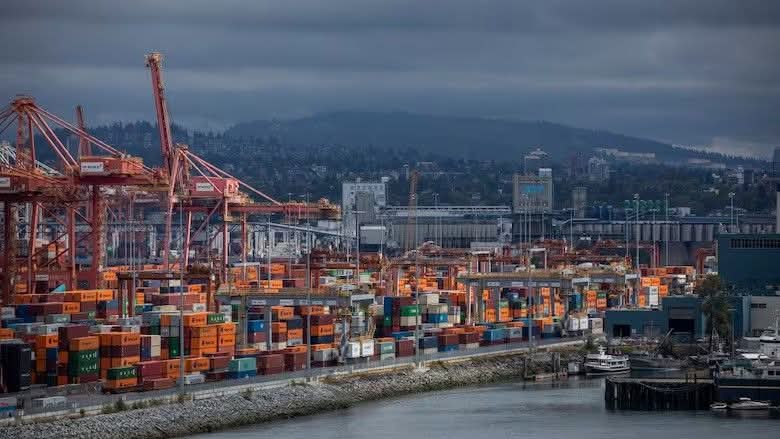
Transport trucks carry cargo containers to be loaded on the
Canada’s economy contracted in the second quarter as U.S. tariffs and trade uncertainty tanked Canadian exports.
But few economists are raising the alarm about Canada possibly being in a recession, and not all forecasters are convinced the economic weakness will push the Bank of Canada to cut interest rates next month.
Statistics Canada said Friday that real gross domestic product declined 1.6 per cent on an annualized basis in the second quarter thanks to a sharp drop-off in exports and business investment.
That’s down from annualized growth of two per cent in the first quarter, a figure StatCan revised down Friday from 2.2 per cent originally.
U.S. President Donald Trump ratcheted up his tariffs against Canada and the world in the second quarter, particularly targeting steel, aluminum and autos.
“It should come as no surprise that the Canadian economy struggled in Q2 as tariffs ramped up,” said Benjamin Reitzes, BMO’s managing director of Canadian rates and macro strategist, in a note to clients Friday.
Economists expected a sharp slowing in growth last quarter as businesses seemed to rush orders early in the year to get ahead of tariffs — boosting activity in the first quarter and cooling the economy off in the second.
Last quarter saw net exports take 8.1 percentage points away from real GDP growth — Reitzes noted that was the second highest toll on record, behind only the COVID-19 pandemic.
Exports of vehicles, industrial machinery and travel services were sharply down last quarter, and business investment in machinery and equipment also sank.
RBC assistant chief economist Nathan Janzen said in an interview that he sees more mixed signals in the data beyond the headline number.
Weakness in the Canadian economy was concentrated in trade-exposed sectors last quarter, he said, while relative strength in consumer spending helped offset the impact.