
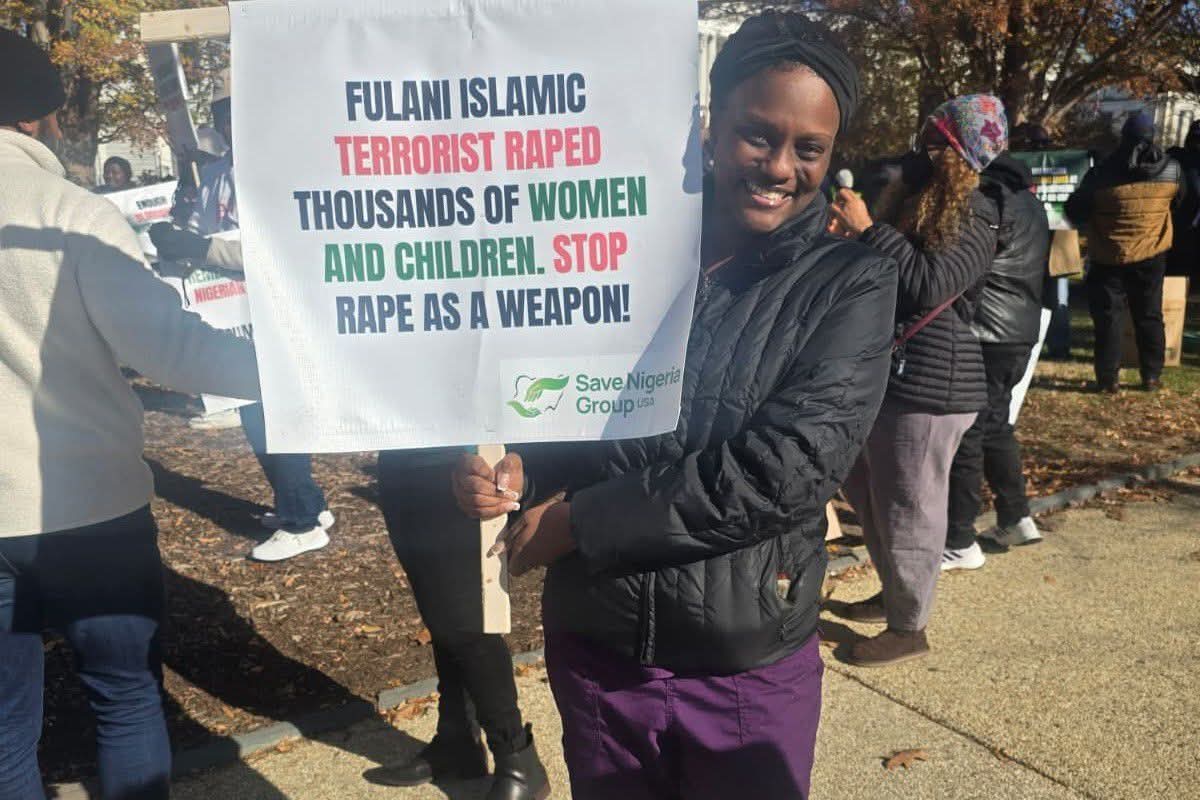
Braving winter cold on the grounds of the United States Capitol, hundreds of Nigerian immigrants rallied on Tuesday to demand stronger American intervention in what they described as systematic religious and ethnic violence in their home country.
Organized by the Save Nigeria Group USA, the demonstration drew participants from across the United States as well as activists from other African nations and Americans who have lived or traveled in Nigeria.
The group said more than fifty two thousand Nigerians have been killed in the ongoing sectarian violence and that nearly eleven million others are trapped in internally displaced persons camps.
Demonstrators carried placards, chanted prayers and held moments of silence for victims as speakers condemned what they called a long standing failure of the Nigerian government to protect its people.
Stephen Osemwegie, president of the organization, addressed the crowd with a mix of grief and urgency. “We gather today not because of the buildings behind us but because of the truth we are speaking, the justice we are demanding, and the lives we refuse to forget,” he said.
He described attacks in Plateau, Benue, Kaduna, Taraba, Southern Kaduna, Borno and parts of the Southeast as a relentless effort to remove Christian communities. “This is not random violence. This is not farmer- herder conflict. This is a systematic campaign of religious and ethnic cleansing carried out by jihadist militias and protected by political actors. Call it what it is: A Christian genocide.”
Mr Osemwegie praised President Donald Trump for redesignating Nigeria as a Country of Particular Concern on November 1, calling the move a critical first step toward international pressure. “President Trump saw what many refused to see,” he said. “He acted when others sat in silence.”
The protest also focused on what the speakers described as structural failures in Nigeria’s political system. The organizers argued that the 1999 Constitution imposed after years of military rule undermines regional autonomy and fuels instability.
They called for a return to a constitutional framework similar to the one in place at independence in 1960, which they said better protected religious and cultural diversity.
Quoting former Nigerian President Olusegun Obasanjo, who recently warned that citizens have the right to call for international intervention when their government cannot ensure their safety, the protesters urged Washington to intensify diplomatic and legislative efforts. “Nigeria’s government has failed,” Mr Osemwegie said. “The moment for global action is now.”
The group urged the United States Senate Majority Leader, John Thune, to bring Senator Ted Cruz’s bill, S.2747, to the floor for a vote. The bill seeks to impose sanctions on sponsors of terrorism, freeze assets linked to illicit finance, and target officials accused of sheltering armed groups.
They also called on the House of Representatives to pass two resolutions, H Res 860 and H Res 866, both of which describe the killings as a Christian genocide and call for formal documentation of atrocities.
Speakers demanded full enforcement of the Country of Particular Concern designation through sanctions, visa restrictions and criminal referrals for Nigerian officials, security personnel and financiers accused of terror sponsorship, coverups of massacres, oil theft and exploitation of displaced communities. “Blood money must not continue flowing through American banks or global markets,” one speaker said.
Protesters on their route to the rally ground in Washington DC
The group also urged the Federal Bureau of Investigation to release more than 2,000 redacted pages related to past investigations involving President Bola Tinubu, including a civil forfeiture case involving four hundred thousand dollars that the group linked to heroin trafficking.
“Truth is not optional,” they said. The protesters further demanded that Chicago State University stop what they called obstructive behavior in disputes surrounding the president’s academic records.
The crowd also raised the case of Sunday Jackson, a Nigerian farmer sentenced to death for killing a Fulani herdsman during what supporters describe as self defense. “Free Sunday Jackson,” the group chanted. “Protect defenders, not terrorists.”
Much of the rhetoric drew from Scripture, with speakers insisting that their call was not motivated by anger but by moral duty. “We are not asking America to fight our battle,” Mr Osemwegie said. “We are asking America to stand for the values it already claims. Freedom. Human dignity. Truth. Justice. The sanctity of every life.”
At the close of the rally, a select delegation from the Save Nigeria Group met privately with United States diplomats at the request of the State Department for a two- hour closed door session.