
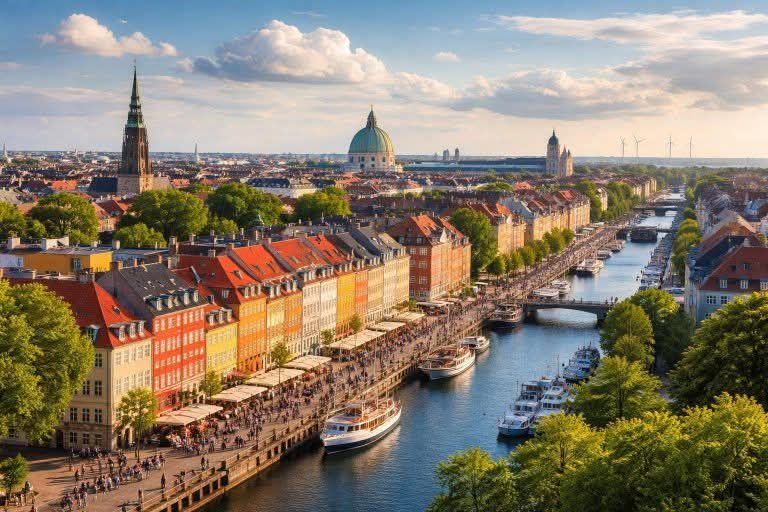
Copenhagen has been named the happiest city in the world for 2025, according to the latest Global Happy City Index released by the Institute for Quality of Life. The ranking evaluates 200 cities worldwide using a wide range of indicators that measure how well urban environments support human well-being.
The annual index assesses cities across six major pillars: governance, environment, economy, mobility, citizens, and health. A new health category was added this year, placing stronger emphasis on mental wellbeing, access to healthcare, safety, nutrition, and work-life balance.
Denmark’s capital emerged at the top for its strong combination of education, sustainability, income levels, and social infrastructure. The report highlights Copenhagen’s emphasis on lifelong learning, with a significant portion of residents engaged in continuous education and a high share holding postgraduate degrees. The city also maintains one of the shortest average workweeks globally, reinforcing its reputation for prioritizing work-life balance.
Copenhagen’s environmental record also played a major role in its top ranking. Nearly 70 percent of all transport in the city qualifies as green mobility, while air quality levels remain among the cleanest in major global cities. Residents benefit from widespread access to green spaces, universal healthcare, and extensive mental health services.
Zurich placed second on the list, driven by its strong income levels, world-class universities, efficient public transport, and exceptionally low traffic fatality rates. Singapore ranked third, praised for safety, economic opportunity, innovation, and efficient governance, alongside very low unemployment and strong healthcare access.
Other cities completing the top five include Aarhus in Denmark and Antwerp in Belgium. Aarhus scored highly for education, environmental quality, and work-life balance, while Antwerp stood out for healthcare access and educational attainment.
The index also identified strong performers across Europe, Asia, North America, and Oceania. Notably, two United States cities made the top 30 list: New York City and Minneapolis, recognized for innovation, green spaces, and urban livability improvements.
Researchers behind the ranking emphasize that happiness is not defined by a single factor but by how effectively cities design policies that support daily life. They note that no city is perfect, but the highest-ranked locations consistently invest in education, public health, sustainability, and inclusive governance.
The full list of the world’s 30 happiest cities includes Copenhagen, Zurich, Singapore, Aarhus, Antwerp, Seoul, Stockholm, Taipei, Munich, Rotterdam, Vancouver, Vienna, Paris, Helsinki, Berlin, New York City, Geneva, Oslo, Dublin, Milan, Reykjavik, Auckland, Adelaide, and Minneapolis, among others.
The 2025 rankings reinforce a growing global pattern: cities that balance economic strength with social wellbeing, environmental responsibility, and access to opportunity are increasingly defining what urban happiness looks like in the modern world.
The top 30 happiest cities
1. Copenhagen
2. Zurich
3. Singapore
4. Aarhus, Denmark
5. Antwerp, Belgium
6. Seoul
7. Stockholm
8. Taipei, Taiwan
9. Munich
10. Rotterdam, Netherlands
11. Vancouver
12. Vienna
13. Paris
14. Helsinki
15. Aalborg, Denmark
16. Berlin
17. New York City
18. Dresden, Germany
19. Brussels
20. Geneva
21. Porto, Portugal
22. Barcelona
23. Oslo
24. Dublin
25. Milan
26. Roskilde, Denmark
27. Reykjavik, Iceland
28. Auckland, New Zealand
29. Adelaide, Australia
30. Minneapolis
Source: Condé Nest Traveler