
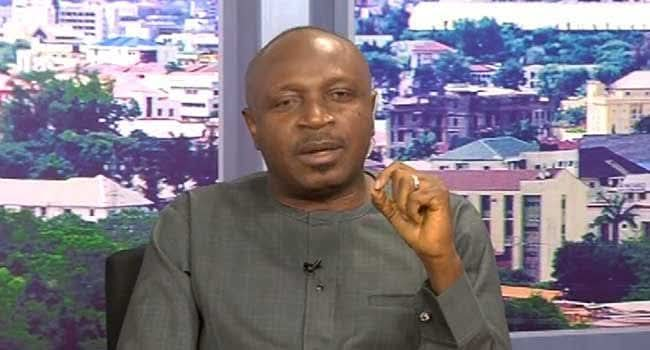
Phrank Shaibu, a senior aide to former Vice President Atiku Abubakar, has criticised presidential spokesperson Daniel Bwala following a recent interview on Al Jazeera, accusing him of spreading falsehoods and attempting to rewrite political history.
In a statement on Saturday titled “Weep not for Bwala, Weep for Nigeria,” Shaibu said he read Bwala’s latest remarks about the interview “with a mixture of suppressed disgust and embarrassment — not for ourselves, but for the sheer enthusiasm with which he parades falsehoods as though repetition could somehow elevate them into truth.”
The statement described Bwala’s recent posture as surprising, noting that “Bwala’s sudden discovery of courage and rhetorical flourish is rather amusing, especially from someone whose political trajectory has been defined less by conviction and more by opportunistic merchandising of allegiance.”
Shaibu also alleged that Bwala once sought the help of the Atiku Media Team to promote a claim that President Bola Tinubu and his associates were threatening his life.
“We remain in possession of his message requesting that the Atiku Media Team issue a press statement claiming that President Tinubu and his associates were threatening his life,” Shaibu said. “He was quite insistent that we amplify that narrative at the time.”
According to him, the request was rejected because it was viewed as politically motivated.
“We declined deliberately because we recognised it for what it was: a frivolous and opportunistic attempt at political theatre, consistent with his long-established penchant for turning politics into a marketplace where loyalty is traded like a commodity,” he said.
Shaibu also dismissed Bwala’s portrayal of his interview with journalist Mehdi Hassan as a successful defence of the administration.
“His attempt to recast the Mehdi Hassan interview as some heroic act of intellectual bravery is equally amusing,” Shaibu said. “Anyone who watched that exchange objectively saw something quite different.”
He argued that the interview instead revealed contradictions in Bwala’s previous statements about President Tinubu.
“The interviewer methodically dismantled the talking points he came armed with and exposed, one after the other, the contradictions between his past statements and his present posture,” Shaibu said.
He further criticised Bwala for reportedly dismissing earlier comments about Tinubu as mere political rhetoric.
“Bwala was confronted with his own words about President Tinubu — statements he once made with remarkable certainty — only to retreat into the tired refuge that ‘it was politics,’” he said. “But it is both wicked and morally bankrupt to dismiss matters of grave national consequence as mere politics.”
Shaibu added that attempts to trivialise issues of national security were unacceptable.
“The wastage of thousands of Nigerian lives to insecurity over the past two years cannot be brushed aside with that cynical refrain,” he said. “To trivialise such human tragedy as ‘politics’ is nothing short of wickedness, an admission of abysmal failure, and sheer madness.”
The statement also accused Bwala of struggling to defend the government’s record during the interview.
“At several points, the interviewer’s persistence reduced his defence of both his principal and the government’s record to a series of evasions and rhetorical detours,” Shaibu said. “What Nigerians witnessed was not the fearless demolition of hostile journalism he now imagines, but the uncomfortable spectacle of a spokesperson struggling to reconcile shifting loyalties with inconvenient facts.”
He added that the exchange “tore through the carefully constructed narrative he attempted to present and left both his arguments and the government’s talking points in tatters.”
Shaibu also took aim at Bwala’s claim that he was willing to face any interviewer.
“Bwala boasts about being willing to appear before any interviewer anywhere in the world,” he said. “But the challenge is not appearing on every television platform across the globe; the real challenge is defending the indefensible.”
The statement concluded with further criticism of Bwala’s political consistency and communication style.
“What remains astonishing is not merely the elasticity of his political loyalties, but the gusto with which he now attempts to launder them as principle,” Shaibu said. “History, unfortunately for him, keeps receipts. And so do we.”