
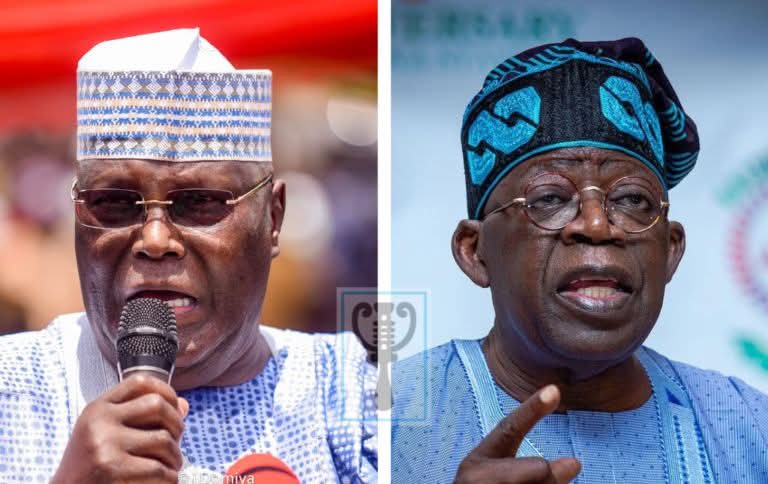
Former Vice President Atiku Abubakar has launched a blistering attack on President Bola Tinubu over the administration’s economic policies, accusing the President of mistaking Nigerians’ suffering for evidence of economic success.
Atiku, in a statement issued on Friday by his Senior Special Assistant on Public Communication, Phrank Shaibu, said Tinubu lacked the moral standing to accuse him of economic ignorance after policies that, according to him, had weakened household purchasing power while increasing government revenues.
He described the administration’s handling of the economy as “economic arson followed by propaganda about the ashes,” arguing that the simultaneous fuel-price, exchange-rate and cost-of-living shocks had left millions of Nigerians poorer.
“If economic ignorance had a presidential seal, Tinubu and his family would be its official logo,” Shaibu said.
He added: “A government that grows richer while its citizens grow poorer is not reforming an economy. It is extracting from its people.”
Atiku also rejected the Presidency’s criticism of his proposal for a petroleum-sector intervention, insisting that his position did not amount to a return to the allegedly corrupt and open-ended fuel subsidy regime.
According to him, the proposed mechanism would be targeted, capped, budgeted, time-bound and independently audited, with its implementation tied to domestic production and safeguards against arbitrage.
He accused Tinubu of removing fuel subsidy without putting in place an adequate transition plan or sufficient measures to cushion the inflationary impact.
“Those three words were not economic policy. They were economic vandalism by presidential fiat,” Atiku said, referring to Tinubu’s declaration that “subsidy is gone.”
He argued that the subsequent increase in petrol prices triggered higher transportation and production costs, accelerated pressure on food prices and eroded household purchasing power.
The former vice president said it was therefore unreasonable for the Presidency to accuse him of inconsistency for adjusting his economic prescriptions to changed circumstances.
“That is not inconsistency. That is economics. Only incompetence insists on yesterday’s prescription after today’s conditions have changed,” he said.
‘What exactly did Tinubu remove?’
Atiku’s strongest criticism centred on what he described as continued petroleum-sector under-recoveries and energy-security costs despite the Federal Government’s declaration that fuel subsidy had ended.
Citing figures he attributed to NNPC’s audited accounts, he claimed that the accounts contained approximately ₦17.5 trillion in energy-security costs and petroleum under-recoveries, including about ₦7.13 trillion classified as Energy Security and ₦8.67 trillion in under-recoveries.
“So what exactly did Tinubu remove?” Atiku asked.
“If subsidy is dead, why are under-recoveries alive? If corruption was eliminated, why has opacity survived?”
He accused the administration of giving Nigerians “the worst of both worlds” by removing what he described as the relief provided by subsidy while retaining opaque petroleum-sector costs.
“Nigerians got the pain; government kept the bill,” he said.
Atiku attacks FAAC argument
The ADC presidential candidate also dismissed the argument that one of the benefits of subsidy removal was the increase in monthly Federation Account Allocation Committee (FAAC) disbursements to states.
He argued that larger allocations to state governments should not be celebrated if they came at the expense of citizens’ purchasing power.
“You do not build a federation by impoverishing citizens so that Abuja can send bigger cheques to governors. That is robbing households to subsidise governments,” he said.
According to Atiku, the increased allocations risk creating dependency among states rather than encouraging them to develop productive economies, attract investment, expand their tax bases and exploit their comparative advantages.
“That is not fiscal federalism. It is fiscal sedation and rascality,” he said.
He further argued that there was little developmental value in transferring resources from households to government treasuries without corresponding improvements in infrastructure, healthcare, education, employment and living standards.
Demands answers on revenues, 2026 budget
Atiku also challenged the Presidency to explain what he described as approximately ₦30 trillion in Federation Account revenues, deductions, savings and transfers, as well as ₦12.8 trillion allocated to the Service-Wide Vote in the 2026 budget.
He said the administration should be as willing to answer questions about public finances as it was to respond to political attacks.
“If Tinubu can mobilise an army of propagandists to attack Atiku within hours, surely he can find one accountant to explain his books,” he said.
Atiku maintained that the increase in government revenues following subsidy removal and the naira’s flotation should not be regarded as evidence of economic success if ordinary Nigerians continued to experience declining purchasing power and rising living costs.
“Economic reform is not measured by how fat government accounts become while citizens grow poorer,” he said.
Concluding the statement, Atiku declared: “The real ignorance is believing suffering is economic policy. Tinubu removed the subsidy from Nigerians’ pockets, but he is yet to remove the questions from his books.”
He added: “Nigerians have paid enough for Tinubunomics. They should not be sentenced to another four years of the bitter experiment.”