
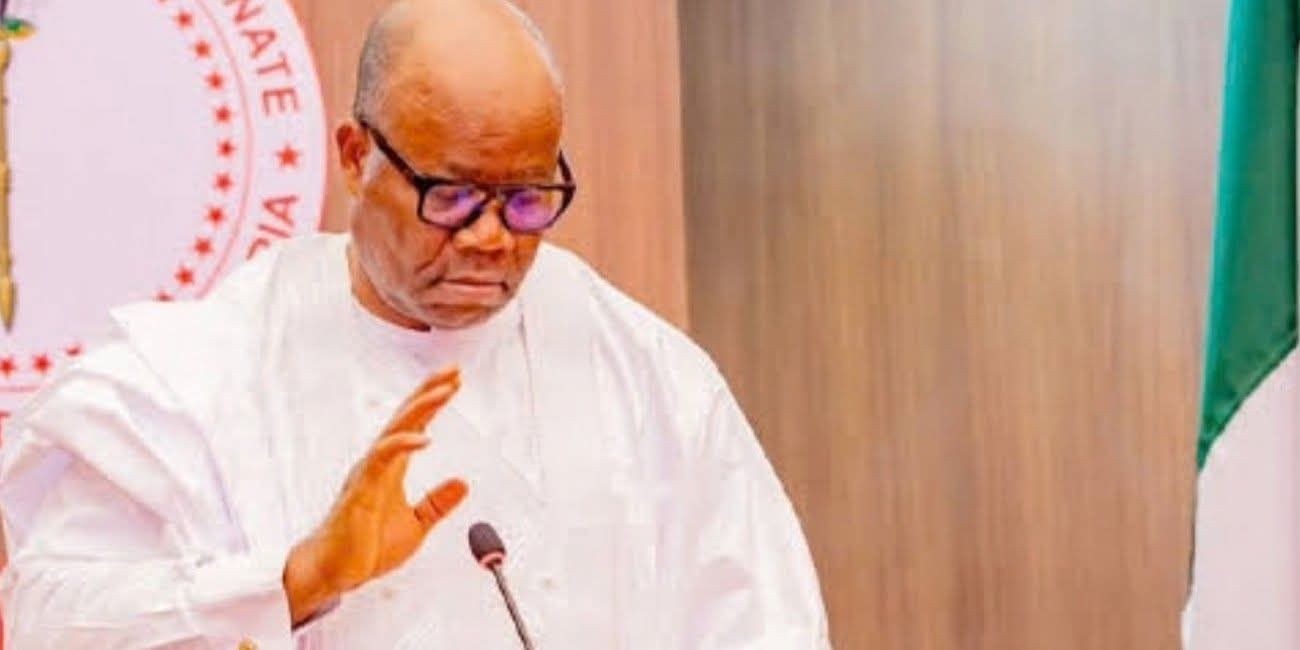
Senate President Godswill Akpabio has said he travelled to Rome, Italy, to pray for Nigeria and seek divine intervention against insecurity, banditry and terrorism.
Akpabio said he embarked on what he described as a “slight pilgrimage” and spiritual journey to pray for President Bola Tinubu, Vice President Kashim Shettima, himself, and members of the National Assembly and the Federal Executive Council.
Speaking about his trip to Rome in a viral video seen by SaharaReporters, Akpabio said he visited the Catholic capital and prayed for Nigeria as a whole.
“Well, I had to go to Italy and, you know, Rome is the capital of the Catholic Church and the world’s capital when it comes to Christianity,” Akpabio said.
“And from there I touched Saint Padre Pio Mazzolio and I did supplications.
“I prayed not just for the president, not just for myself, the vice president and all members of the Senate and National Assembly and the Federal Executive Council.
“I prayed for Nigeria as a whole and I also prayed against insecurity that God should free us from insecurity.”
“I prayed against banditry. I prayed against terrorism,” Akpabio added.
The Senate President said his decision to embark on the spiritual journey was rooted in his Christian belief that divine protection was necessary for the efforts of those working to secure the country.
“And it might look funny but it’s the truth because in our own religion, we believe that unless God protects the house, the watchmen watch in vain,” he said.
“And so I decided to take this slight pilgrimage, a spiritual journey to pray for Nigeria. I believe strongly,” he added.
Akpabio’s comments come amid persistent insecurity across several parts of Nigeria under the administration of President Bola Tinubu, with communities continuing to face killings, kidnappings, bandit attacks and terrorist violence.
The security crisis has remained particularly acute in the North, where Boko Haram and Islamic State West Africa Province (ISWAP) continue to operate, while armed banditry has spread across parts of the Northwest and into other regions.
The Armed Conflict Location & Event Data (ACLED) says Nigeria is also facing instability linked to cult and political militias as well as farmer-herder conflicts.
Human Rights Watch, in its 2026 World Report, said insecurity remained prevalent across Nigeria in 2025, citing deadly attacks in Borno State, continued killings and kidnappings in the Northwest and persistent intercommunal violence in the Northcentral region.
Data cited by the European Union Agency for Asylum from ACLED recorded 8,654 security incidents across Nigeria between January 2024 and December 2025, including 4,829 incidents classified as violence against civilians. Borno, Katsina and Zamfara recorded the highest numbers of security incidents during the period.
The security challenges have also continued into 2026.
In August, gunmen attacked communities in Niger State in a mass kidnapping in which residents said hundreds of women, children and elderly people were abducted. Reuters reported that the incident exposed continuing security challenges as Nigeria approaches the 2027 general elections.
More recently, the deaths of 37 people detained by the Nigeria Security and Civil Defence Corps (NSCDC) following raids on suspected illegal mining sites in Niger State triggered protests in Minna. President Tinubu ordered an investigation and suspended senior NSCDC officials, while saying that those found responsible should face accountability.
The government has maintained that its security agencies are intensifying operations against terrorists, bandits and other criminal groups, while also pursuing non-military measures in some affected areas.