
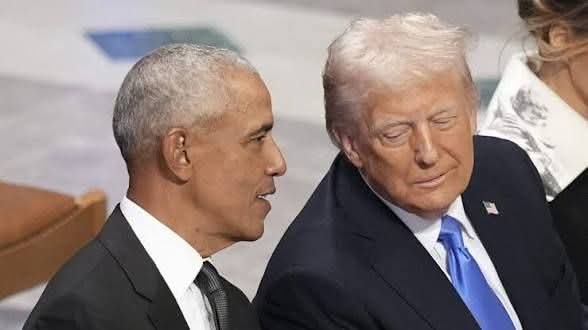
President Donald Trump did not mince words when asked about the notion of women in charge of governments and former President Barack Obama’s suggestion that the world would improve under female leadership.
During an event with historian Doris Kearns Goodwin at Salem State University last week, Obama remarked that during his time in office, he “sometimes fantasized about, if you put women in charge of every government for like two years, and then just kind of saw, all right, how are things going?”
“I have a strong belief that things would ― they wouldn’t be perfect ― but they’d be better. I’m confident about that,” he added.
While speaking to the press on Saturday, Trump responded to a question about the 44th president’s claim.
“Barack Obama just said if you put women in charge of every government for two years, things would be better. Do you buy that?” one reporter asked.
“It’s a ridiculous ― I love women, I think they’re great, but what a ridiculous statement that is, right? Even you would say that,” Trump replied.
Experts in politics and gender studies say the president’s remarks in the interview are quite telling. When asked about the president’s remarks, the White House referred HuffPost to Trump’s original comment.
“Obama is empirically right that the world would look radically different if women were in charge,” Caroline Heldman, a professor of political science and the chair of gender, women and sexuality studies at Occidental College, told HuffPost. “Decades of research finds that women world leaders have different policy priorities, governing styles, ethics, foreign policy approaches and responses to crises than men leaders.”
She noted that women officeholders tend to give more attention to issues like healthcare, education, childcare, parental leave, pay equity and violence against women.
“They place greater emphasis on collaboration, consensus-building and cross-party coalitions; demonstrate lower levels of corruption; are more likely to favor diplomacy, multilateral cooperation and humanitarian aid; and are more effective in reaching peace agreements,” Heldman added. “During COVID-19, women-led countries acted earlier, followed expert guidance more closely, communicated more clearly and saw better health outcomes.”
She was careful to note that none of this is about biology or innate differences ― but rather stems from “gendered socialization, the expectations placed on women leaders and the pressure women face to prove their competence in male-dominated institutions.”
Heldman also presented a thought experiment to get a sense of how different the world could be if women were in charge.
“Imagine how different the U.S. would look if half of our presidents from the start had been women,” she said. “How would the U.S. be different if Hillary Clinton were elected in 2016? I assure you that had Kamala Harris been elected in 2024, we would not be in a foreign quagmire in Iran, we would not be paying $6.36 in California for gas, we would not be paying an average of $1,700 in extra household costs from new tariffs and we would actually know what’s in the Epstein files.”
Political scientist Shauna Shames, an associate professor at Rutgers University-Camden who studies gender and American politics, offered two reads of Trump’s remarks.
“The less charitable read … is that Trump may indeed love women, but for certain things only, and not when they wield political power,” she said. “When they do, he tends to give them pretty awful nicknames and do a lot of mocking and ridicule. It is the first refuge of an insecure man.”
Throughout his time in the spotlight, Trump has lobbed several insults at women, from calling leaders like Hillary Clinton and Kamala Harris “nasty” to going after celebrities like Jessica Chastain (“not hot”), Bette Midler (“extremely unattractive”), Stormy Daniels (“horseface”) and Rosie O’Donnell (“fat” and “a pig”).
And then there are all of his attacks on female reporters ― including telling Bloomberg’s Catherine Lucey “Quiet, piggy!”, dismissing CNN’s Kaitlan Collins as “very dumb and unhappy,” dubbing Maggie Haberman “Maggot Hagerman” and calling The New York Times’ Katie Rogers “ugly.”
“Donald Trump’s claim that he loves women is not borne out by his dismissal of their superior leadership, nor the reports of serious sexual abuse against him,” Heldman emphasized.
Kari Winter, a professor of global gender and sexuality studies at the University of Buffalo placed Trump’s dismissal in a broader context.
“According to the International Committee of the Red Cross, military conflicts are escalating globally to the tune of approximately 130 armed conflicts across 60 countries,” she said. “Donald Trump’s administration responds by calling for testosterone shots and greater lethality. After launching a reckless war of choice against Iran, Trump in his United Nations speech brought enormous shame on the United States by threatening the ‘annihilation’ of an ancient civilization.”
Winter was equally pointed about Trump’s track record more broadly.
“Listening to the doomsday scenarios that Trump and his bombastic ilk casually, stupidly and unimaginatively spout day after day, the world can observe that Trump excels at generating horrific new problems,” she said. “At the same time, it appears that he has never met a problem that he was capable of solving.”
As for Trump’s specific response to Obama’s comments, there was a clear familiar pattern.
“Given the dire state of the male-dominated world, Barack Obama’s invitation for us to imagine a world led by women makes a lot of sense. But Trump cannot imagine a better world,” Winter said. “In his nine-second response to the reporter’s question, he hits three of his habitual knee-jerk notes: disrespecting women, demeaning reporters, and dismissing as ‘ridiculous’ any idea to which he cannot formulate a reasoned response. His statement reveals nothing new. It hits the same sour notes we’ve heard time and again, ad nauseam.”