
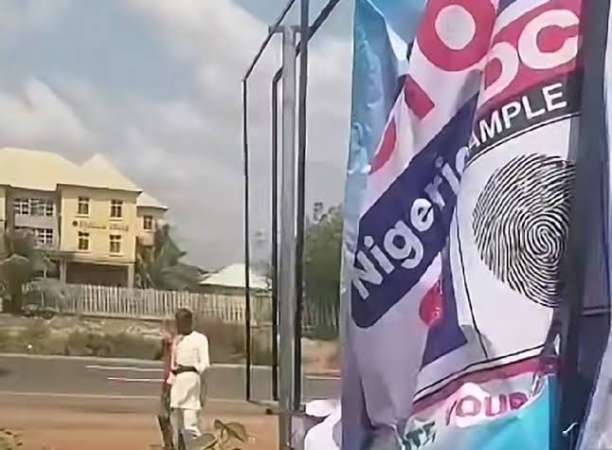
The removal of campaign billboards featuring Nigeria Democratic Congress (NDC) presidential candidate, Peter Obi, in Anambra State has triggered a fresh political controversy, with Governor Chukwuma Soludo’s administration facing questions over its handling of opposition campaign materials ahead of the 2027 general election.
The controversy followed the dismantling of a campaign billboard belonging to Senator Victor Umeh, who represents Anambra Central Senatorial District, after it featured his senatorial ambition alongside Obi’s presidential candidacy.
The development has raised concerns about the implications of the state’s campaign advertising regulations, particularly as the affected politicians belong to the NDC, an opposition party whose presidential candidate is expected to challenge President Bola Tinubu in the forthcoming election.
According to reports, Umeh had paid ₦20 million to the Anambra State Signage and Advertisement Agency (ANSAA) for his senatorial campaign advertisements and obtained the necessary permit before deploying his campaign materials.
However, the senator’s campaign organisation reportedly became concerned after officials dismantled some of his billboards displaying his photograph alongside those of Obi and his running mate, Senator Rabiu Musa Kwankwaso.
The campaign organisation subsequently contacted ANSAA to establish the reason for the action.
It was alleged that the agency informed the senator’s representatives that the billboards had been destroyed and confiscated on the orders of the state government because they featured Obi and Kwankwaso, who are contesting the presidency and vice-presidency on the NDC platform.
A source within the agency reportedly explained that Umeh could restore the affected billboards only by replacing the campaign flexes without Obi’s photograph.
The source further claimed that the state government would continue removing campaign materials featuring Obi until the presidential candidate paid the stipulated ₦50 million presidential campaign advertising permit fee.
The controversy has drawn attention to Anambra’s campaign advertising fee structure, which was announced by ANSAA ahead of the 2027 elections.
Under the arrangement, presidential candidates are required to pay ₦50 million for outdoor campaign permits, while senatorial candidates are charged ₦20 million. Other categories of candidates also have different prescribed fees.
The policy has generated questions about whether a senatorial candidate who has fulfilled the applicable requirements must obtain an additional permit whenever another candidate appears alongside him on campaign materials.
GOVERNMENT DEFENDS ACTION
However, the Soludo administration has rejected suggestions that the billboard was removed because of Obi’s identity or political affiliation.
The state’s Commissioner for Information and Value Reorientation, Dr Law Mefor, said the action was based on compliance with the Anambra State Signage and Advertisement Agency Law rather than hostility towards any political candidate.
According to the government’s explanation, Umeh had paid the prescribed fee for his senatorial campaign but had not fulfilled the separate financial requirement applicable to Obi as a presidential candidate.
The government maintained that a single campaign permit could not automatically cover two candidates contesting different political offices.
Soludo’s Senior Special Assistant on New Media, Izuchukwu Adichie, also defended the position, telling Umeh that payment for his senatorial campaign did not cover Obi’s presidential campaign.
“If Senator Victor Umeh wants to put Peter Obi’s face on his billboard, let him pay Peter Obi’s rate as well. Peter Obi is running for president. ANSAA needs money!” Adichie reportedly wrote.
The government consequently maintained that any campaign billboard featuring candidates who had not fulfilled the applicable advertising requirements could be removed, irrespective of their political party or status.
Nevertheless, the explanation has not eliminated the political controversy surrounding the enforcement action, particularly given the timing and the identities of the politicians involved.
TINUBU’S CAMPAIGN RALLY ADDS POLITICAL DIMENSION
The billboard controversy has also coincided with preparations for President Tinubu’s 2027 re-election campaign rally in Anambra State.
Soludo, who is leading the state’s presidential campaign council for Tinubu’s re-election, hosted the APC’s campaign rally, tagged ‘SoluTinubu 2027’, at Dr Alex Ekwueme Square, Awka, on Thursday, November 19.
Vice-President Kashim Shettima represented Tinubu at the event, which attracted APC and APGA political leaders and supporters.
The coincidence between the removal of Obi’s campaign materials and the Tinubu campaign rally has fuelled speculation among opposition supporters that the action could have political undertones.
Obi, a former governor of Anambra State, remains one of the major opposition figures in the 2027 presidential contest. His political activities in the state are therefore likely to attract considerable attention as the election approaches.
The controversy is particularly sensitive because Anambra is Obi’s home state and a significant political base for his presidential ambition.
Questions are consequently emerging over how the Soludo administration will balance its political support for Tinubu with its constitutional and democratic responsibility to guarantee a level playing field for opposition parties and candidates operating in the state.
While the government insists that it is enforcing an existing law, critics could argue that the application of such regulations must be transparent, proportionate and consistent, especially when they affect the ability of opposition candidates to communicate with voters.
Beyond the immediate disagreement between the government and Umeh’s campaign organisation, the incident has reopened the debate over the affordability of political participation in Nigeria.
With presidential campaign advertising permits in Anambra fixed at ₦50 million, concerns may arise over whether such financial requirements could disproportionately affect candidates and political parties with fewer resources.
The central question is whether the state’s advertising regulations are being applied uniformly to all political interests or whether their implementation could create unnecessary obstacles for opposition campaigns.
As the 2027 election approaches, the handling of this controversy could become an important test of the Soludo administration’s commitment to political pluralism, fair competition and democratic freedoms in Anambra State.
