
Canada’s annual inflation rate edged up to 3.2 per cent in May, according to Statistics Canada, with rising gas prices pushing inflation up as the cost of fresh fruits and vegetables also soared.
The high cost of gas, driven by an oil shortage due to the war in Iran, was the driving force behind the uptick for another month, according to Statistics Canada. The price of gasoline rose at a faster pace in May, with prices increasing 33.2 per cent on a year-over-year basis, compared to 28.6 per cent in April.
Those costs pushed the annual inflation rate to its highest level since late 2023.
However, BMO chief economist Doug Porter noted that pump prices have eased in recent weeks, which he says will likely bring the headline inflation figure down in the next inflation report.
Excluding the impact of gasoline prices, the consumer price index still posted a higher increase of 2.2 per cent in May from two per cent in April, led by the elevated cost of food, recreation and alcoholic beverages.
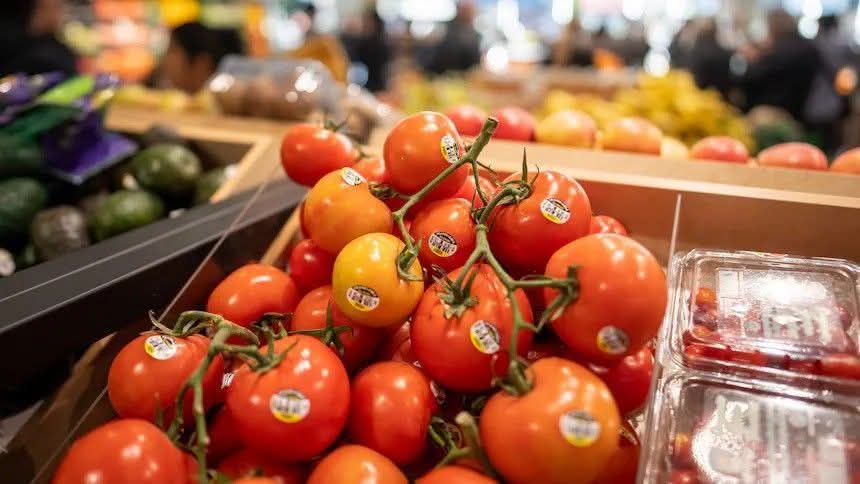
Prices for fresh fruit rose by 5.3 per cent compared to the same time a year ago, while the cost of fresh vegetables rose nine per cent in May. Tomatoes in particular soared by 45.2 per cent, which the data agency said was due to poor weather and less planting of the crops in Mexico as a result of U.S. tariffs — a reminder that trade uncertainty is still weighing on the economy, according to Pedro Antunes, chief economist at Signal49 Research.
Did Trump take tomato? Here’s what’s behind the latest grocery price sticker shock
The month-over-month increase in vegetable prices of 5.5 per cent was the largest increase for May since 2008, according to Statistics Canada, and came as a result of reduced supply and higher fuel costs.
The cost of fresh produce drove the rate of inflation for groceries overall to 4.3 per cent year over year for the month of May.
Prices for computer equipment, software and supplies, meanwhile, rose 3.9 per cent in May, as the cost of random access memory (RAM) and solid state drives (SSDs) required for computers has increased. Demand from artificial intelligence data centres has resulted in a supply crunch for key computer inputs, according to Statistics Canada.
a person with short hair in a tshirt and yeans fuels up a white SUV at a gas station
A gas station with a price of 204.9 per litre is pictured in Surrey, British Columbia, on Friday, Mar. 13, 2026. (Ben Nelms/CBC)
Shelter costs grew at a slower pace — 1.7 per cent year over year — in May, helping offset rises in other areas. Prices were also growing at a slower pace for passenger vehicles, tools and other household equipment.
Analysts polled by Reuters had estimated the annual inflation rate to touch three per cent in May, up from 2.8 per cent in April.
Abbey Xu, an economist with RBC, noted that measures of core inflation that strip out more volatile items were right around two per cent, which is the Bank of Canada’s target for the inflation rate. While food and energy have risen quickly, it seems that price growth in other categories is still subdued, Xu noted — meaning the cost of gas isn’t filtering too much into the cost of other goods.
Still, BMO’s Porter says the high overall rate stings.
“The persistence of food inflation is a significant thorn, and we have to rate this one as a mild disappointment overall — it’s never good news to see the overall inflation rate track above three per cent, even if it is for one month only,” Porter wrote in a note to investors.