
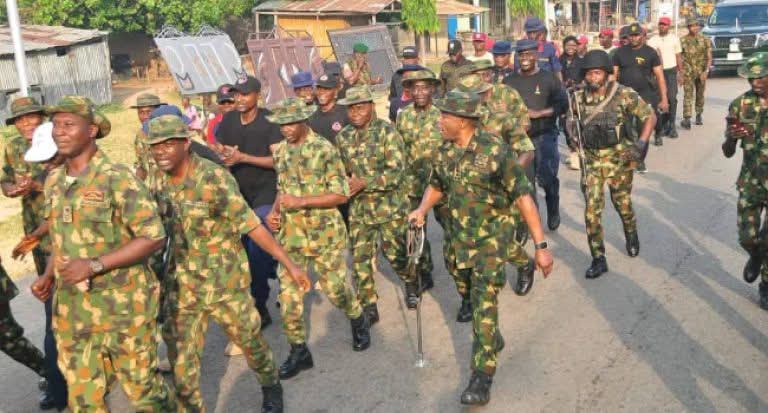
Nigerian soldiers engaged in counter-insurgency operations in the North-East have expressed concerns over an alleged directive requiring them to work alongside former Boko Haram members who were recently reintegrated into society under the Borno State Government’s deradicalisation programme.
Military personnel who spoke on condition of anonymity said the development has generated unease among troops deployed across parts of Borno State, with fears that the arrangement could expose military operations to intelligence leaks and compromise ongoing efforts against insurgent groups, reports The Guardian.
According to the soldiers, some former Boko Haram fighters who publicly renounced violence and pledged allegiance to the Nigerian State during recent reintegration exercises have been attached to local security groups supporting military operations in the state.
The personnel alleged that the move forms part of efforts by the Borno State government to demonstrate the effectiveness of its rehabilitation and reintegration initiative, which has faced criticism from victims of insurgency, members of the public and some security operatives.
The soldiers, however, maintained that many troops remain sceptical about the sincerity of some former insurgents despite their participation in rehabilitation programmes.
One soldier said the deployment of former insurgents alongside security groups has raised concerns among frontline troops.
“The government wants to prove that the reintegration programme is working, so some of these ‘repentant’ Boko Haram members are being attached to security groups that work with troops in operations,” the soldier said.
“But many of us are uncomfortable with the arrangement because there have been cases in the past where information leaked and operations were compromised. Trust is a major issue.”
Another military source said troops have continued to exercise caution around some of the former fighters because of fears that they could still maintain ties with active terrorist networks.
According to the source, some of the ex-terrorists are accommodated separately within military facilities due to lingering security concerns.
“We don’t trust them completely. There have been too many incidents in the past. That is why they are often given separate accommodation. Yet now there is pressure for us to work closely with them during our missions,” the source said.
The soldier further argued that recurring attacks on military commanders by insurgents have heightened suspicions about possible information leaks.
“You can see how these Boko Haram fighters have been killing our commanders. That should tell you there is a leak in information about their movements. Yet the government is asking us to trust these people and work with them. It won’t work,” the source added.
The personnel urged the federal government to prioritise the provision of improved equipment, intelligence support and welfare packages for troops rather than compelling them to collaborate with former insurgents.
They warned that the alleged directive has heightened anxiety among soldiers who fear that sensitive operational information could be exposed to insurgent groups still active across Borno State and neighbouring areas.
The concerns emerged weeks after the Borno State government reintegrated 720 former insurgents, alongside 992 spouses and 2,050 children, into various communities under its “Borno Model” deradicalisation and rehabilitation programme.
The beneficiaries were among individuals who surrendered to security forces and subsequently underwent rehabilitation at the Hajj Camp in Maiduguri before being returned to their communities.
Speaking during the reintegration ceremony, retired Brigadier-General Abdullahi Ishaq, Special Adviser on Security to Governor Babagana Zulum and a member of the state’s Deradicalisation, Rehabilitation and Reintegration Committee, described the programme as a key component of the state’s non-kinetic approach to tackling insurgency.
He said the initiative, launched in July 2021, is based on forgiveness, rehabilitation and community acceptance of former insurgents willing to abandon violence.
According to Ishaq, more than 350,000 individuals have left insurgent camps and surrendered since the programme began, while 9,680 persons have been reintegrated through nine batches.
He stated that participants undergo vocational training, counselling, religious and behavioural reorientation, as well as skills acquisition programmes before being reintegrated into society.
Despite these efforts, the programme has remained controversial, with critics questioning whether former insurgents can be fully trusted and whether sufficient safeguards exist to prevent a return to extremist activities.
The latest concerns from serving soldiers underscore the continuing debate surrounding the reintegration policy and its implications for security operations in the North-East.
Attempts to obtain a response from the Nigerian Army were unsuccessful as of the time of filing this report.
Several calls placed to the Director of Army Public Relations, Colonel Appolonia Anele, were not answered. A text message seeking the Army’s reaction to the allegations was also delivered but had not received a response at the time of publication.