
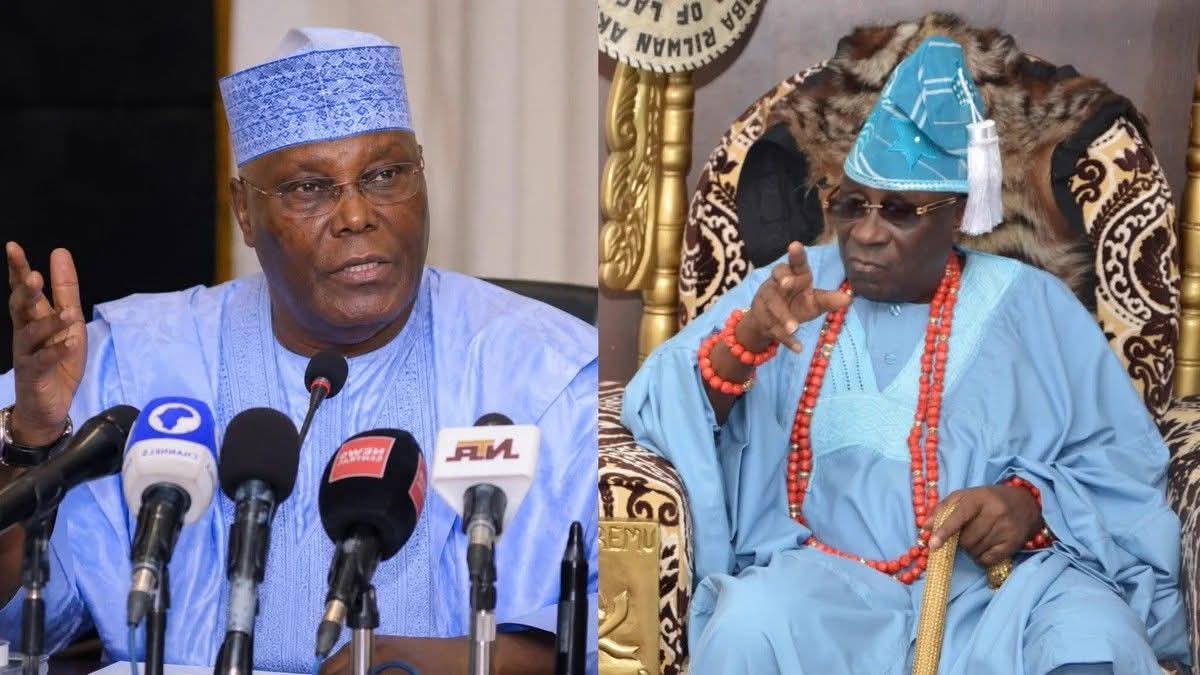
Former Vice President and African Democratic Congress (ADC) presidential candidate, Atiku Abubakar, has responded sharply to the Oba of Lagos, Oba Rilwan Akiolu, following the monarch’s public endorsement of President Bola Ahmed Tinubu’s bid for another term in office.
The Oba of Lagos had declared that there would be “no vacancy in Aso Rock” for the next four or five years while receiving the Director-General of the Tinubu Presidential Campaign Council, Abdulaziz Yari, and members of his delegation at the Lagos palace.
Reacting to the monarch’s declaration, Atiku said the Nigerian presidency could not be determined by a traditional ruler or any individual outside the electoral process. He stressed that the authority to choose the country’s president ultimately rests with Nigerian voters through the ballot.
In a statement issued through his Senior Special Assistant on Public Communication, Atiku said traditional rulers were entitled to express their political preferences but could not determine the outcome of a presidential election on behalf of the electorate.
“Kabiyesi, with due respect, Aso Rock is not an extension of your palace, and Nigeria’s presidency is not a royal stool for you to allocate,” Atiku said.
He was responding directly to the Oba’s assertion that there would be no vacancy at the Presidential Villa for the next four or five years, a statement widely interpreted as an endorsement of President Tinubu’s 2027 re-election bid.
Atiku maintained that the outcome of the 2027 presidential election would be determined by Nigerians when they cast their votes.
“There will be a vacancy in 2027 because the Constitution says so. You may endorse Tinubu, but you cannot endorse him on behalf of over 200 million Nigerians,” he said.
The ADC candidate further argued that the Nigerian presidency was not a traditional institution in which succession could be determined by royal endorsement.
“The people, and not kings, courtiers or APC campaign councils, will decide that through the ballot,” he added.
Atiku also used the opportunity to draw attention to the economic and security challenges confronting Nigerians.
He said that while people within privileged circles might not experience the full effects of the current economic difficulties, millions of Nigerians were dealing with rising living costs, hunger and insecurity.
“While the palace may be insulated from today’s hunger, insecurity and crushing cost of living, millions of Nigerians are counting every painful day until 2027,” Atiku said.
The exchange has added a new dimension to political activities ahead of the 2027 general elections, particularly the growing engagement between presidential campaign organisations and traditional institutions.
The Oba of Lagos received the APC Presidential Campaign Council as part of its political consultations and engagement ahead of the election. During the visit, the monarch publicly expressed support for President Tinubu’s continued stay in office.
The development illustrates the increasingly visible role of traditional rulers in political consultations, even though electoral authority remains vested in the constitutional and electoral process.
Atiku, who served as Nigeria’s vice president from 1999 to 2007, is among the politicians preparing to contest the 2027 presidential election. His response to the Lagos monarch therefore places the disagreement within the broader political contest surrounding the next presidential election.
The former vice president also stressed that democracy should not be confused with a process of royal succession.
“Kabiyesi, democracy is not coronation. You may have a preferred candidate, but you do not have the authority to declare Nigeria’s presidential election settled before Nigerians vote,” he said.
His comments have since generated discussion about the relationship between traditional institutions and partisan politics in Nigeria.
Traditional rulers frequently receive politicians and political delegations seeking blessings, advice and community support. However, their constitutional position differs from that of elected officials and political parties, whose authority to seek and exercise political power is determined through elections and other constitutional processes.
The latest exchange also comes at a time when political parties and presidential aspirants are intensifying consultations across the country ahead of 2027.
For Atiku, the central issue is that no endorsement by an individual, political organisation or traditional institution can substitute for the votes of Nigerian citizens.
The former vice president concluded his response by reiterating that the choice of Nigeria’s next president belongs to the electorate.
The disagreement between Atiku and the Oba of Lagos has consequently become one of the latest public exchanges in the emerging 2027 political discourse, with both the role of traditional institutions and the authority of voters taking centre stage.
As political consultations continue, traditional rulers are expected to remain important stakeholders for parties and candidates seeking community engagement. At the same time, the final determination of who occupies the presidency will be made through the constitutional electoral process and the votes cast by Nigerians in the 2027 presidential election.