
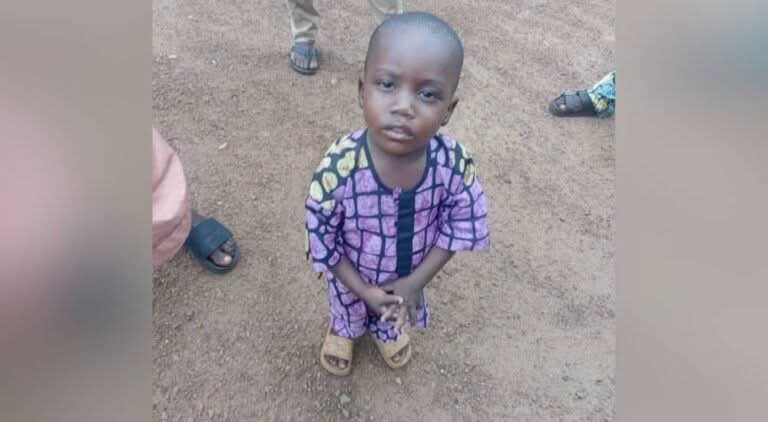
The father of a two-year-old boy abducted alongside 39 pupils and six teachers from schools in Oriire Local Government Area of Oyo State has revealed that his son is still struggling with psychological trauma weeks after regaining freedom.
Sikiru Abiodun, a farmer in Yawota community, said his toddler has not been the same since returning from 56 days in bandits’ captivity.
The child was among those abducted on May 15, 2026, when armed bandits attacked Baptist Nursery and Primary School, Yawota; L.A. Primary School; and Community Grammar School, Ahoro-Esienle.
The victims were eventually rescued on July 10 and taken to the LAUTECH Teaching Hospital for medical evaluation and psychological assessment before being reunited with their families.
Speaking to THE WHISTLER in Yoruba, Abiodun described the troubling changes in his son’s behaviour. “Before he was abducted, if he wanted to sleep, he would just go and sleep by himself. But since he came back, anytime he wants to sleep, he will start crying and he would not stop until we hug or carry him.”
The farmer also noticed that his son now reacts with extreme distress whenever he is scolded.
“Anytime he’s doing something or wants something and we shout at him; he will start crying also.
He was not like that before,” Abiodun said. Despite the changes in his son’s behaviour, Abiodun expressed gratitude that the boy returned alive.
“We’re just happy that he came back alive because we had lost hope of seeing him again,” he stated.
The toddler’s story is not an isolated case. A frightened four-year-old girl in the Ahoro-Dada community bolted in terror when she saw cameras and microphones, mistaking them for the guns that had shattered her world on May 15. Her terrified parents eventually caught up with her, held her gently by the hands and repeatedly assured her that the visitors were not kidnappers.
The reaction of the little girl revealed that while the victims had regained their freedom, many have remained prisoners of fear. Though they might have left the forest, for many of them, the forest has refused to leave their minds.
Clinical psychologists warned that the effects of kidnapping on young children can be profound and long-lasting.
According to Sabina Ebadan, a clinical psychologist, kidnapping is not only a security incident but a deeply traumatic experience that can leave lasting mental health consequences if victims do not receive professional support.
She explained that rescued victims may experience acute stress reactions such as shock, confusion, emotional numbness, panic attacks, sleep difficulties and poor concentration immediately after the ordeal. Some may later develop Post-Traumatic Stress Disorder (PTSD), characterised by flashbacks, nightmares, fear of returning to school or work, hypervigilance, avoidance of discussions about the incident, and difficulty sleeping or concentrating.
The psychologist noted that affected children may become withdrawn, aggressive or unusually clingy, while teachers may struggle with emotional exhaustion, anxiety and reduced confidence in returning to the classroom.
The Nigerian Medical Association (NMA) has also warned that freedom from captivity does not necessarily mark the end of the ordeal for survivors.
Professor Afekhide Ernest Omoti, NMA President, stressed that survivors require immediate and comprehensive medical attention, trauma-informed psychological care and long-term rehabilitation to recover fully from the hidden effects of captivity.
He warned that untreated physical injuries, infectious diseases, malnutrition and post-traumatic stress disorder (PTSD) are among the health challenges that can persist long after victims regain their freedom. Research suggests that between 30 and 70 per cent of kidnapping survivors may develop PTSD, with the risk particularly high among those who experienced prolonged captivity, physical or sexual assault, repeated threats to life, or witnessed the abuse or death of others.
Zaccheaus Olatunde, one of the seven teachers rescued after spending 56 days in captivity, recounted the horrors they endured. He described how two of his colleagues – Mr Michael Oyedokun and Deacon John Olaleye – lost their lives under brutal circumstances.
The adult male captives were kept inside makeshift tents, their hands handcuffed and their legs chained for virtually the entire period.
Their eyes were often blindfolded, while even basic human needs depended on the permission of their captors. If they wanted to urinate or defecate, they had to beg them. The terrorists rarely stayed in one place, moving the captives from one forest location to another to avoid detection by security forces.
Most days, the captives survived on plain rice or rice mixed only with palm oil, without pepper or salt.
The terrorists prohibited Christian prayers among the captives, beating them mercilessly whenever they were caught praying.
The Nigerian Bar Association (NBA), Ikirun Branch, has called on the Federal Government and the Oyo State Government to establish specialised trauma rehabilitation centres for victims of violent crimes, saying the rescue of the victims must be followed by long-term healing and institutional reforms.
The NBA expressed concern over the psychological impact of the 56 days the victims spent in captivity, noting that most of the survivors are young children.
“Child psychology dictates that these raw, uncensored experiences of violence, torture and unreported sexual abuse will be deeply integrated into their developing minds.
The societal victory of their physical rescue remains incomplete until comprehensive, long-term measures are taken to heal their invisible wounds,” the statement said.
Similarly, Senator Natasha Akpoti-Uduaghan has called for immediate psychological support for the rescued victims, stressing that emotional recovery should be treated with the same urgency as their physical wellbeing. She urged the federal and state governments to work with relevant agencies to ensure the victims receive comprehensive mental health support, noting that survivors of kidnapping often bear invisible emotional scars that require professional counselling and coordinated rehabilitation to enable them to reintegrate successfully into their families, schools and communities.
The Nigerian Psychological Association (NPA) has also warned that the victims may have escaped captivity but remain trapped by deep emotional wounds, urging the government to immediately provide professional mental health care to aid their recovery.
The association stressed that many of the victims could suffer from post-traumatic stress disorder (PTSD), anxiety, depression, nightmares, fear, withdrawal, poor concentration, and other long-lasting psychological challenges if left without proper care. The NPA called for immediate psychological assessment, trauma-informed counselling by qualified psychologists, family counselling, school-based reintegration programmes, long-term mental health support and community sensitisation to prevent stigma against the victims.
The traumatic experience has also left many parents reluctant to send their children back to the affected schools, despite their successful rescue.
One relative, Fausat Akindele, said the incident had permanently changed many parents’ perception of the schools’ safety.
Another family member, Basirat Adigun, said: “No parent wants to take any risk after what these children went through.
“We appreciate the efforts that brought them back, but we need to see concrete security measures around the schools and the communities before we can think of returning them.”
Reacting the Oyo State Commissioner for Information and Orientation, Mr Dotun Oyelade, described the parents’ concerns as understandable.
“It is understandable if parents do not want to send their children back to those schools. As human beings, the emotional trauma which they have undergone will ordinarily not allow them to freely release their children to further their education because of the nightmare,” he said.
He added that the state government had already begun implementing interventions to improve infrastructure in the affected schools.