
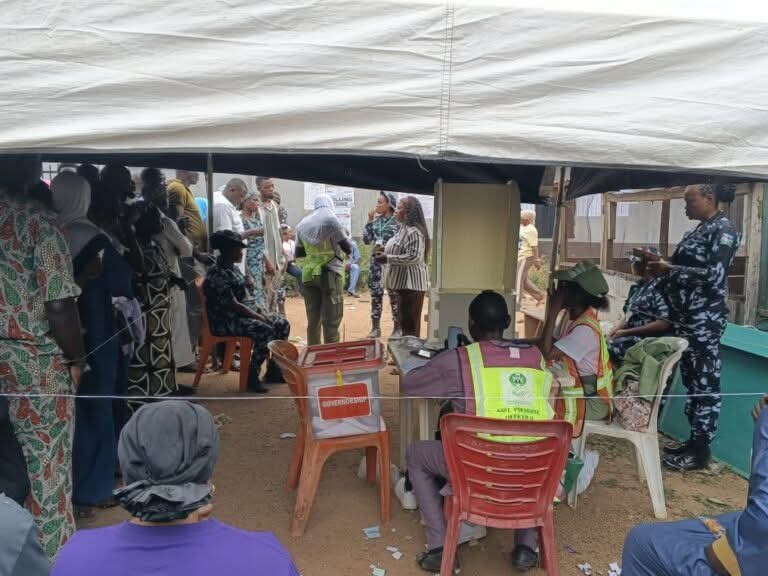
As voting was still underway during the August 15, 2026, governorship election in Osun state, a video caught my attention on social media. In the video, some individuals claimed that they had been given N50,000 each to vote for a particular candidate. The claim immediately stood out because of the sheer amount involved and, more importantly, because it raised a broader question about how much political actors are now willing to spend to influence voters in Nigerian elections.
The claim in the video has not been independently verified, and the N50,000 figure should therefore be treated with caution. But seeing the claim while the election was still taking place prompted a question that goes beyond that particular video: is the price of vote-buying rising in Nigeria, and could the country’s prolonged economic hardship and inflation be contributing to that increase?
The question is particularly relevant when the Osun election is considered alongside the June 20, 2026 governorship election in Ekiti state. Reports from election observers, journalists and civil society groups documented or alleged cash inducements to voters in both elections, with several credible accounts placing the payments in the N10,000–N20,000 range. At the same time, higher figures, including claims of N30,000 and N50,000, circulated around the Osun election, although those amounts require greater verification.
For years, Nigerian elections have been described as a marketplace where political power and money intersect. But as the purchasing power of the naira changes and millions of Nigerians struggle with rising food, transportation and household costs, another disturbing possibility is emerging: the nominal amount political actors are willing to offer voters may also be increasing.
From the few thousand naira reportedly offered in some previous elections to the N10,000, N15,000 and N20,000 payments documented or alleged in recent contests and now the claims of N50,000 in Osun, the figures invite a difficult question: Is inflation beginning to inflate the price of Nigeria’s vote?
The latest Osun governorship election offered one of the clearest illustrations of the growing financial dimension of electoral competition.
Ahead of the August 15 poll, reports emerged that agents of the two leading parties, the All Progressives Congress and Accord, were allegedly distributing cash and other items to prospective voters in several parts of the state.
Reports cited by the media indicated that alleged payments varied from one location to another. In some communities, voters reportedly received N10,000, while other accounts put the amount at N15,000 or N20,000 or N50, 000
A report published around the election described alleged N20,000 payments in Ilesa and reported different amounts in other local government areas. Some voters also alleged that political agents collected bank details with promises of payment after voting.
The allegations were not limited to cash. Reports also described the distribution of rice, salt and other items alongside money.
Some videos circulating before the election also purported to show people receiving money and taking oaths to support particular candidates. However, the provenance and circumstances surrounding some of those videos were disputed, making it important to distinguish independently corroborated reports from unverified social-media claims.
The pattern nevertheless raises serious questions about the extent to which money has become embedded in electoral competition.
Ekiti and the Wider Pattern
The concern is not limited to Osun. During the June 20 Ekiti governorship election, election observers also documented allegations of cash inducements. Reports from the field placed some alleged payments between N10,000 and N20,000, with observers documenting instances in which voters were allegedly approached by political agents with financial offers. Such reports are significant because they provide another data point in an emerging pattern across Nigeria’s off-cycle governorship elections.
The evidence does not mean that every voter was paid, nor does it establish that every political party or candidate participated in vote-buying. Vote-buying is often clandestine, highly localised and difficult to measure.
What the evidence does suggest is that where inducements occurred, the sums being reported are no longer confined to the relatively small amounts associated with some previous elections.
From Thousands to Tens of Thousands
The comparison with earlier elections provides an important context. Reports from previous Nigerian elections have often cited vote-buying payments in the range of a few thousand naira. By the 2023 off-cycle elections, however, some reports documented considerably larger amounts in particular locations. The reported figures from Bayelsa in 2023, for example, reached more than N20,000 in some accounts.
It would be dangerous to turn these scattered figures into a rigid national price index for votes. There is no official “vote price” published by INEC, and payments vary according to location, party, competitiveness of the polling unit and the resources available to political actors.
However, the repeated appearance of five-figure payments is nevertheless difficult to ignore. In some parts of Nigeria, the reported amount attached to a vote appears to have moved from thousands of naira into the tens of thousands. That is where the idea of “vote-buying inflation” becomes useful.
What Does Inflation Have to Do With It?
Inflation does not automatically cause politicians to increase vote-buying payments. There is no simple economic formula that says a rise in the Consumer Price Index must produce a corresponding increase in the amount offered to voters. However, inflation changes the value of money.
The same N10,000 does not necessarily provide the same purchasing power today that it provided several years ago. Nigeria’s economic reforms, rising food and transport costs and broader cost-of-living pressures have placed households under considerable financial strain.
The latest official data show headline inflation at 15.91 per cent in June 2026, while reports continue to highlight the pressure that food, fuel, housing and other basic expenses are placing on Nigerian households. In such an environment, political operators attempting to induce voters may face a different economic calculation.
If ₦5,000 no longer carries the same purchasing power or attraction that it once did, a political actor seeking to persuade a voter through cash may have to offer more. That does not prove that inflation is the sole reason for the increase. Political competition, campaign financing, poverty, voter expectations and the availability of political funds can all influence the amount offered. However, inflation provides an important part of the explanation.
A Vote Is Not a Commodity — But Politics Is Treating It Like One
There is something deeply troubling about discussing an election in terms of the “price” of a vote. A ballot is supposed to represent a citizen’s political choice. It is one of the few instruments through which an ordinary citizen can exercise equal political power with a wealthy individual. Vote-buying turns that principle upside down.
Instead of asking what a candidate intends to do about education, healthcare, security, unemployment, infrastructure or the economy, voters can be placed under pressure to consider what they will receive immediately. The politician sees the payment as an electoral investment. The voter, particularly one experiencing economic hardship, may see it as immediate relief. That distinction is important.
For a struggling household, N50,000 can represent food, transport, school expenses or part of a utility bill. A politician may therefore be exploiting not simply political loyalty but economic vulnerability.
Does Receiving Money Mean the Vote Was Bought?
Not necessarily. One of the complications surrounding vote-buying in Nigeria is that accepting money does not guarantee that a voter will ultimately support the person who provided it. Some voters may collect inducements from political actors while privately intending to vote according to their own preference. This makes vote-buying a risky investment for politicians.
However, the practice remains damaging even when the money does not determine the final result. It normalises the idea that elections should come with financial rewards. It encourages politicians to compete through spending rather than ideas and creates incentives for candidates to seek ever-larger campaign war chests.
Over time, the political system becomes increasingly expensive. And when elections become expensive, access to political power can become increasingly dependent on access to money.
The most dramatic claims surrounding the Osun election involved allegations that voters were being offered as much as N50,000 and more per head. Those claims attracted significant attention on social media. Some claims were also publicly disputed or denied. The financial mathematics of vote-buying can quickly become enormous. If 500 voters were each given N20,000, the total would be N25million. If the same amount were distributed to 1,000 voters, it would reach N50million.
Across multiple wards and local government areas, the potential expenditure could therefore run into hundreds of millions of naira. This is why journalists investigating vote-buying should look beyond the person handing over the cash.
The bigger question is, who financed the operation? Where did the money come from? Who authorised the payments? Were the funds withdrawn from personal accounts, campaign accounts or other sources? Were party agents given predetermined amounts? Were voters’ names, phone numbers or bank details recorded? Were cash withdrawals unusually high in the days before the election? These questions can transform an election-day story into a deeper investigation into political financing.
Following the Money
The financial trail may ultimately tell a bigger story than the money handed to individual voters. A serious investigation should examine campaign spending, political party finances, suspicious withdrawals, cash movements and other sources of campaign funding. It should also examine allegations involving public resources.
In Osun, for example, political opponents traded accusations over N50,000 payments to workers, with one side alleging that the payments were politically motivated and the government rejecting the allegation. Such claims should be independently examined rather than automatically accepted as evidence of vote-buying. The question for journalists is not simply who made the allegation. It is whether there is documentary evidence showing where the money came from, why it was paid, who received it and whether it was connected to electoral support.
Poverty and the Politics of Survival
The economic dimension of vote-buying cannot be ignored. A voter who is financially secure may be less susceptible to a N20,000 or N50,000 inducement than someone struggling to feed a family. That does not mean poor voters lack political consciousness. It means that economic hardship can change the calculation surrounding an immediate financial offer.
This is why the fight against vote-buying cannot be separated entirely from the fight against poverty.
Nigeria’s electoral framework prohibits vote-buying and other forms of inducement intended to influence voters. Yet the persistence of the practice suggests that the deterrent effect remains inadequate. Political actors can be warned before elections that vote-buying is illegal. Police and electoral authorities can announce that offenders will be arrested. But the decisive question comes after the election:
How many people were actually arrested? How many were prosecuted? How many were convicted? Without credible enforcement, the financial calculation remains attractive. If a political actor can spend millions of naira buying votes and faces little prospect of prosecution, the legal prohibition becomes less effective as a deterrent. That is why election authorities and law-enforcement agencies need to move beyond warnings and demonstrate that electoral offences have consequences.
What Journalists Should Investigate
The next phase of reporting should focus on the money trail. Journalists should interview voters anonymously and establish how much they were offered, who made the offer, whether payment was made before or after voting, whether bank details were collected and whether recipients were threatened or pressured. They should interview party agents and campaign officials and ask whether cash was distributed, how much was allocated per polling unit and who authorised the distribution. They should also seek financial records and examine unusual withdrawals in the weeks leading to the election. Election observers should be asked to provide their full polling-unit reports, including locations where vote-buying was observed or suspected.
Most importantly, allegations from competing political parties should be treated with equal caution. A party accusing its opponent of vote-buying does not, by itself, prove the allegation. The evidence must be independently established.
Nigeria’s Electoral Marketplace Is Getting More Expensive
The most important conclusion from Ekiti and Osun is not that every Nigerian vote now costs N50,000. It does not. The more defensible conclusion is that reported vote-buying payments in some competitive elections have moved into the N20,000–N50,000 range, while Nigeria’s continuing cost-of-living pressures provide a plausible economic backdrop for that increase. That distinction matters. There are too many variables involved to claim that inflation alone is responsible.
Political competition has intensified. Campaign spending has increased. Parties have developed more sophisticated mobilisation structures. Poverty and economic vulnerability remain widespread. All of these factors can push the amount of money involved in electoral inducement upwards.
However, inflation adds another dimension: the purchasing power of the money itself has changed. A ₦50,000 payment may look enormous when compared with the N5,000 figures associated with some earlier elections, but its real economic impact must be understood within the context of what ₦50,000 can actually buy today. That is the real meaning of vote-buying inflation.
The Price of a Vote Should Never Be the Price of Survival
The danger is not merely that politicians are spending more money. It is that economic hardship may be making citizens more vulnerable to that spending.
When an election becomes an opportunity to collect money, rice, salt or other immediate benefits, the democratic relationship between citizens and politicians begins to change. Citizens are no longer simply choosing leaders. They are being approached as electoral investments. And politicians are no longer competing only over who can present the most convincing vision for government. They may also be competing over who can afford the largest electoral inducements.
If that trend continues, Nigeria could face a vicious cycle: economic hardship makes voters more vulnerable to inducements; increased inducements make elections more expensive; expensive elections increase the importance of political money; and the growing importance of political money further marginalises citizens who cannot compete financially.
The ultimate victim is therefore not simply the voter who receives N20,000 or N50,000. It is the democratic system itself. The question Nigeria must confront before the next major election is no longer simply “How much did they pay? It is “Why has the price of a vote become part of the conversation about the value of democracy?”