
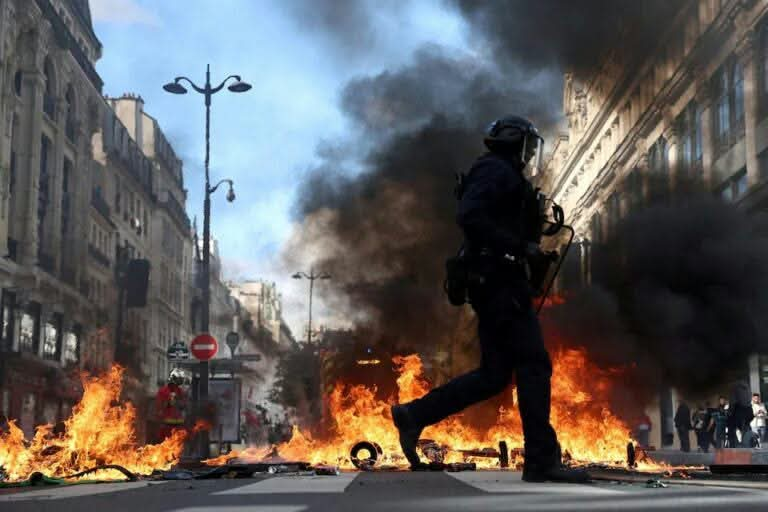
France is facing one of its worst periods of civil unrest in years after nationwide demonstrations over rising living costs and deteriorating public services erupted into violent clashes, leaving one protester dead, more than 2,000 people arrested and hundreds of police officers injured. The violence, which intensified on Saturday, October 17, continued into Sunday as authorities struggled to restore order in Paris and other major cities.
The latest figures represent a significant increase from the initial reports released on Saturday. Prime Minister Sébastien Lecornu had earlier announced 1,200 arrests and 150 injured police officers, but updated figures cited by Reuters on Sunday put the number of arrests above 2,000, with more than 600 officers injured. One demonstrator died after suffering a cardiac arrest during protests in Paris, although authorities have not established that the death resulted from police action.
Interior Minister Laurent Nuñez estimated that approximately 550,000 people participated in Saturday’s demonstrations across France, including about 110,000 in Paris. The General Confederation of Labour (CGT), one of the country’s major trade unions, placed nationwide participation closer to 800,000, illustrating the scale of a movement that has expanded beyond its original student organisers.
The demonstrations began in September when students and teachers protested staff shortages, overcrowded classrooms, deteriorating school buildings and inadequate educational funding. Students subsequently organised blockades and strikes, forcing the closure of hundreds of schools and disrupting learning across several regions.
By October 12, the Education Ministry reported that 130 schools remained closed, down from 172 the previous Friday, while dozens of other institutions continued experiencing disruptions. Education Minister Édouard Geffray had already announced plans to recruit 3,000 additional substitute teachers, but students and unions continued demanding broader improvements to school conditions and public funding.
The unrest also coincided with a shooting at Joseph-Lakanal Middle School in Aubagne on October 12, where a 14-year-old student allegedly wounded the headmaster and a female teacher using a hunting rifle concealed in a guitar case. Both victims survived, and the suspect was arrested after a staff member intervened. Authorities said there was no evidence linking the shooting to the nationwide demonstrations, although the incident heightened concerns about violence affecting French educational institutions.
Saturday’s demonstrations brought together students, teachers, trade union members, workers, farmers and supporters of the Yellow Vest movement, which previously organised prolonged protests against fuel prices and economic inequality. While most participants marched peacefully, groups of masked individuals attacked police officers, set vehicles ablaze, damaged public buildings and looted commercial establishments.
In Paris, violent confrontations developed around Place de la République, where protesters erected burning barricades and police deployed tear gas and water cannons. Shops were broken into, vehicles and bicycles were set on fire, and officers used batons while attempting to disperse crowds. Some businesses closed or evacuated customers as clashes spread through nearby streets.
One of the most destructive incidents occurred in Limoges, where the historic 19th-century town hall was deliberately set ablaze. The fire engulfed much of the building, causing sections of its roof and central tower to collapse. Mayor Guillaume Guérin accused those responsible of carrying out a premeditated attack and demanded government assistance to rebuild the landmark, which had stood for more than 140 years.
Violence was also reported in Marseille, where masked individuals entered City Hall, vandalised sections of the building and attacked police facilities. In Lyon, the city’s tourist office was set on fire, while Bordeaux experienced widespread looting and an attack on the residence of the local prefect. Damage to public buildings and businesses was also reported in Lille, Grenoble, Nantes, Rennes, Toulouse and other cities.
The commercial consequences have been substantial, with hundreds of shops damaged and businesses reporting extensive losses. Carrefour chief executive Alexandre Bompard said 50 of the retailer’s stores were damaged, including 20 that were looted, with losses running into tens of millions of euros. Bordeaux Mayor Thomas Cazenave reported that as many as 100 shops had been looted in his city, while Marseille announced emergency financial assistance for affected businesses.
Tensions persisted on Sunday as fresh confrontations erupted around Place de la République despite efforts to clear damaged streets and remove burnt vehicles. Police again used tear gas against groups of demonstrators, while additional disturbances were reported in Marseille. Municipal workers began extensive cleanup operations as residents and business owners assessed the damage left by Saturday’s violence.
The protests have also renewed scrutiny of French policing methods following serious injuries sustained by demonstrators during earlier confrontations. In Saint-Étienne, Mayor Régis Juanico confirmed that a young man lost his hand following an explosion involving a grenade during Saturday’s protests. A separate incident earlier in October left a 15-year-old injured in similar circumstances, while France’s police watchdog is investigating allegations of excessive force.
President Emmanuel Macron condemned the destruction and pledged that those responsible for vandalism, looting and attacks on public institutions would face prosecution. Prime Minister Lecornu blamed much of the violence on extremist groups and opportunistic criminals, accusing them of exploiting legitimate demonstrations to attack public property and security personnel.
Opposition leaders have offered sharply different assessments of the crisis. Jean-Luc Mélenchon, leader of La France Insoumise, accused the government of aggravating tensions through its handling of the protests and criticised police conduct while condemning looting and arson. Marine Le Pen also denounced the destruction and blamed sections of the radical left for encouraging disorder.
The government faces growing pressure from local authorities seeking financial assistance and changes to policing arrangements. Economy Minister Roland Lescure has promised support for affected businesses, while the mayors of Paris, Lyon and Marseille have requested discussions with Lecornu over security failures and the damage sustained by their cities.
The unrest has extended beyond France, with demonstrations over housing costs, education, living standards and government policies also reported in Belgium, Portugal, Italy and Albania. Police clashed with protesters in Brussels and Milan, while thousands demonstrated in Lisbon over housing affordability. Although the demonstrations reflected similar economic frustrations, they involved different national organisations and demands.
France’s CGT union has called for further peaceful mobilisation and announced plans for a broader inter-union strike on November 5. The organisation is pressing the government for wage and pension increases, stronger public services and taxation reforms, signalling that the protest movement could continue beyond the weekend’s violence.
Macron is scheduled to address the nation on Sunday evening after consultations with senior government officials. The crisis comes ahead of France’s 2027 presidential election, with the government facing pressure to respond to demands over education, public spending and the cost of living while addressing the violence that has accompanied the demonstrations.
