
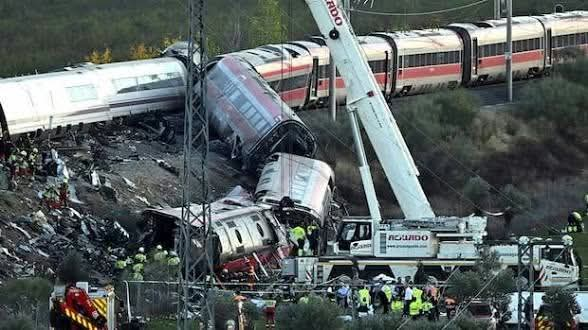
A high-speed train slammed into another that had stopped on the tracks in Spain Wednesday, killing at least 68 people and injuring dozens in the second deadly rail collision this year.
At least six Canadians were injured in the crash, and one other is unaccounted for, according to a spokesperson for Global Affairs Canada. Earlier Wednesday, Prime Minister Mark Carney said at least two Canadians were injured in the train collision, adding that the government is prepared to provide assistance.
“Our thoughts are with their families, the victims and their loved ones — in the days and weeks ahead,” Carney told reporters in Ottawa on Wednesday, adding that the federal government is ready to provide “any assistance” required.
The regional government of Castilla La Mancha confirmed the death toll and said another 58 people were receiving medical treatment at hospitals. Rescue workers continue searching the wreckage for survivors and bodies.
The collision came just nine months after another deadly crash involving high-speed trains operated by the same two companies in southern Spain in January.
“Today all of Spain is grieving,” Spanish Prime Minister Pedro Sánchez said from the crash site, where he announced that his government would declare three days of national mourning.
Prime Minister Mark Carney expressed ‘sadness and solidarity’ with the victims of the high-speed rail crash in Spain in which 64 people were killed and 80 injured Wednesday morning. ‘If there’s assistance that we can give, we would provide,’ Carney said.
Sánchez called for increased safety measures to restore confidence in a high-speed rail system that was once a source of national pride .
“It is unacceptable for a country like Spain to suffer two high-speed rail accidents in the same year,” said Sánchez, who faces a national election on Nov. 29.
Spain’s rail system operator ADIF said the crash occurred Wednesday morning in the central province of Toledo, involving two high-speed trains carrying hundreds of passengers and heading in the same direction from Madrid to Seville in southwestern Spain.
A train operated by the state-owned RENFE company struck the rear of another train operated by private company IRYO that had stopped. The collision derailed two cars in a rural area between two villages.
David Gómez, a construction worker, was working with his brother and another colleague nearby when they heard the crash and ran to help, he told the newspaper El País.
“People were trying to get out through the windows…. We cut through some fences to access the area and treated people with the first-aid kits we had brought,” until emergency services arrived, he said. “As I was trying to pull a young woman out, there was a piece of a leg.”
Spanish soccer federation postpones 24 Copa del Rey games after train crash
Rail service was suspended between Madrid, Ciudad Real and Andalusia.
Before this year, there had been no fatal crash on Spain’s dedicated high-speed lines since the network opened in 1992.
The spouse of a person who is missing is comforted near the site of the train collision on Wednesday in central Spain. (Violeta Santos Moura/Reuters)
Spain’s Transport Minister Óscar Puente said that the crash was caused by what he called the “inexplicable” order from a central command centre for Spain’s trains after a security system had failed. He said the train engineers were not to blame.
Puente said that at 8:30 a.m. local time the security system on a stretch of 63 kilometres stopped working due to a computer malfunction, causing all trains on that stretch to stop. But the central command told the RENFE train to start running again without any speed restrictions, and it ended up colliding with the stopped IRYO train at 8:53 a.m.
Puente said that the train should never have been told to start moving again since there was still a “stop signal” active on that line. And if it had, at least it should have been told to go at reduced speed.
Authorities were still studying information to see how fast the train was going, but it could have been at 200 km/h for that stretch of the track, Puente said.
“I am not attributing responsibility to anyone, I am just stating the facts,” Puente said.
Rescue personnel work at the site of the collision of two high-speed trains Wednesday between the towns of Mora and Orgaz, near Toledo, Spain. (Violeta Santos Moura/Reuters)
The crash, which occurred in a flat stretch surrounded by olive fields in between the towns of Urda and Los Yébenes, left carriages shredded into bits of metal and other material, scattering debris down a gravel slope.
Spanish Health Minister Mónica García said that emergency workers focused on rescuing survivors and bodies from the most damaged train cars.
“It was a high-speed impact, so we are expecting this to be a tragedy,” García said.
Passenger Ignacio Relaño was traveling on the RENFE train. He told state broadcaster TVE that the train had stopped momentarily on the line before it started again and then crashed into the IRYO.
“We all felt the train abruptly slowing down and then the impact,” he said. “The car leaned to one side like it was about to tip over. I hit my nose, everything went flying, luggage, cell phones. Everything shook.”
Driver dead, nearly 90 other people injured after passenger trains collide north of London
Another passenger recounted to Cadena Ser radio how she felt the train slam on the brakes and was thrown forward in her seat, breaking the small table in front of her. She said she saw body parts and trapped people covered in blood.
Authorities said 397 passengers were in the RENFE train and 147 passengers in the IRYO train.
IRYO, an Italian-owned company, said in a statement that it has “activated its security protocols and is closely working with authorities.”
The mayor of the nearby town of Urda, Manuel Galán, said civil protection authorities asked his officials to prepare a sports pavilion to receive injured passengers.
A military emergency brigade was deployed to help emergency services, firefighters and police. Ambulances and medical helicopters made trips to and from the site, while unscathed survivors were put on buses.
Latest crashes shake confidence in Spain’s rail service
Spain’s King Felipe VI and Queen Letizia said in a short statement on X that they were following news of the accident.
“We are deeply saddened and concerned by the train accident in Urda [Toledo],” the royal couple said. “We share in the grief of the families and loved ones of those who lost their lives, and we send our heartfelt support to the injured and all those affected.”
European Commission President Ursula von der Leyen said: “My heart goes out to the victims’ families and loved ones. Today, Europe mourns with you.”
Spain’s soccer federation postponed all 24 Copa del Rey games scheduled on Wednesday.
The wreckage of Wednesday’s crash reminded many of the aftermath of another train collision in January, when 45 people died in southern Spain after a IRYO train jumped the track and hit an oncoming RENFE train. That sent the first two cars of the impacted train plummeting down a four-metre slope.
That crash was the deadliest in Spain since a 2013 crash that killed 80 people.
The January incident shook confidence in the European country’s extensive high-speed rail service.
Canada told CBC News that it is aware of six Canadians injured in the crash, and a seventh person was unaccounted for. The severity of injuries was not clear, with GAC citing privacy considerations. (Manu Fernandez/The Associated Press)
Show next image
Over recent decades, Spain has invested heavily in high-speed rail — which the country’s railway union defines as rails for trains going 250 km/h and over — turning it into a world leader.
Spain has laid some 3,900 kilometres of such tracks over more than three decades for its 49 million residents. Only China, with 45,000 kilometres for its 1.4 billion people, has more high-speed track, according to the International Union of Railways.
Only recently did Spain open its rail network to private companies to compete against RENFE. IRYO started operating in Spain in 2022.
A spokesperson for Spain’s train workers’ union, Joan Rodríguez, said that the increased traffic brought by privatization has put extra strain on rail infrastructure.
“We are not convinced that the liberalization of the high-speed passenger rail service was matched by the necessary upkeep of the lines,” Rodríguez told TVE. “I am not saying it was a determining factor [in the crashes,] but yes, the increase in use of the network is a factor to keep in mind.”
