

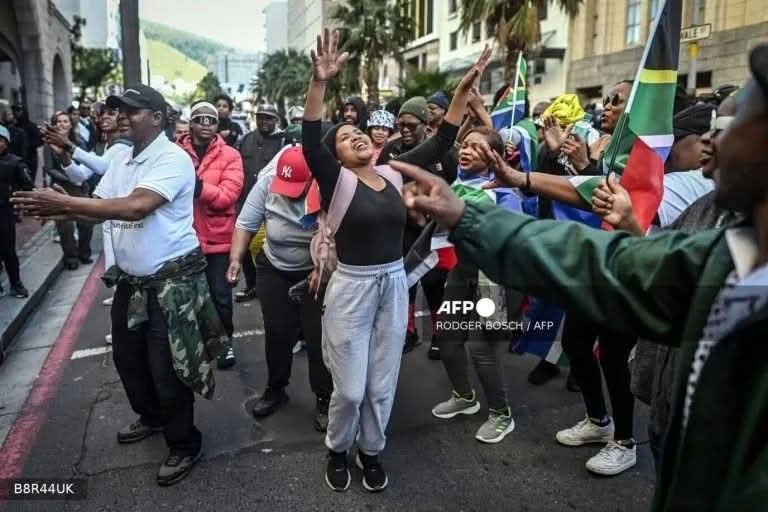
A fresh wave of anti-immigrant protests in South Africa has escalated into an open campaign against Nigerian nationals, with demonstrators demanding that the government prohibit Nigerians from entering the country.
The protesters, operating under the March and March movement, staged a demonstration in Pretoria on Wednesday, November 18, 2026, accusing Nigerians of involvement in drug trafficking and contributing to social problems in South African communities.
According to TheCable, the demonstration was led by the movement’s leader, Jacinta Ngobese-Zuma, who confronted the Nigerian immigrant community in Sunnyside, a Pretoria suburb popularly nicknamed ‘Little Lagos’ because of its sizeable Nigerian population.
Challenging Nigerians to explain the nickname and their presence in the neighbourhood, Ngobese-Zuma questioned who had authorised them to associate parts of South African territory with their home country.
“I am being told here that we’ve entered Sunnyside, the home of Nigerians. I am inviting Nigerians to come out, let’s talk to each other. We want to know who gave you this place and called it Nigeria. Who gave you permission to call this place Lagos or whatever you call it?” she asked.
She argued that the growing presence of foreign nationals was putting additional pressure on public resources and worsening the frustrations of South African citizens.
The movement said it intended to present its grievances to the Department of Home Affairs, demanding stricter immigration controls, restrictions on refugee admissions and faster deportation of undocumented foreign nationals.
Its legal representative, Xolani Zuma, specifically demanded that Nigerians be barred from entering South Africa.
“The state must ban Nigerians from South Africa. They must ban Nigerians until they stop selling drugs to our people. The rest of Africa, we are fine, but we do not want Nigerians in South Africa anymore. That is what we are saying,” he declared.
The protesters also called on the South African government to withdraw from the 1951 United Nations Convention Relating to the Status of Refugees, arguing that its obligations under the international agreement were no longer sustainable.
The demand for a blanket ban on Nigerians, however, represents the position of the protesting movement and should not be mistaken for an adopted policy of the South African government.
DIPLOMATIC RELATIONS UNDER PRESSURE
Wednesday’s demonstration comes against the background of renewed tensions between Nigeria and South Africa over xenophobic hostility, the safety of Nigerian nationals and recent diplomatic disagreements.
The latest development is particularly sensitive because it follows a public disagreement involving Nigeria’s newly accredited High Commissioner to South Africa, Femi Fani-Kayode, and the South African Presidency.
The dispute erupted on November 13 when Fani-Kayode’s prepared remarks were omitted from the South African Presidency’s livestream of the ceremony at which he presented his letters of credence to President Cyril Ramaphosa.
The Nigerian envoy protested the omission, which he considered disrespectful to Nigeria. The South African Presidency subsequently disputed aspects of his account, while a separate video containing his address was released.
Fani-Kayode later indicated that the disagreement had been addressed following engagements involving Ramaphosa and South African diplomatic officials.
Since assuming his diplomatic assignment, the envoy has also identified the welfare and protection of Nigerians living in South Africa as priorities.
He has maintained that those responsible for xenophobic attacks represent a small minority and should not be allowed to define the character of the wider South African population.
The envoy has expressed confidence that Nigeria and South Africa can overcome their disagreements without undermining their longstanding diplomatic relationship.
However, he has also warned that patience within Nigeria’s corridors of power is running thin over repeated attacks on Nigerian citizens, insisting that the country will not abandon its nationals to xenophobic violence.
A TEST FOR BOTH GOVERNMENTS
The latest protest raises fresh questions about the protection of foreign nationals, the management of immigration grievances and the responsibility of both governments to prevent hostility from degenerating into violence.
Nigeria and South Africa share important economic, political and historical connections. Nigeria played a significant role in supporting South Africa’s struggle against apartheid, while both countries remain influential actors in continental diplomacy.
Consequently, renewed hostility against Nigerians could complicate efforts to strengthen bilateral relations, particularly at a time when Fani-Kayode has pledged to rebuild diplomatic bridges between the two countries.
For the Nigerian government, the immediate challenge is ensuring the safety of its citizens while pursuing diplomatic engagement with Pretoria.
For South Africa, the situation presents another test of how its authorities balance domestic concerns over immigration with their obligations to protect foreign nationals from discrimination and collective punishment.
