
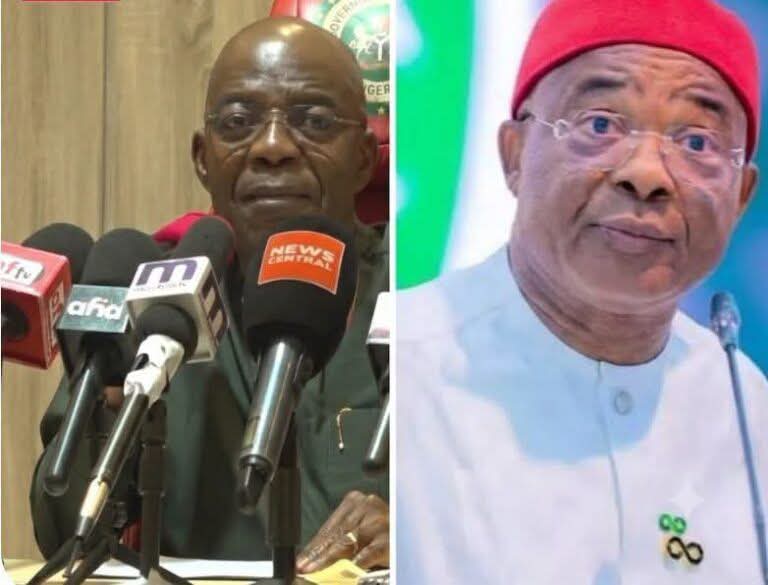
Abia State Governor, Dr. Alex Otti, has distanced himself and the South-East from the recent endorsement of President Bola Tinubu’s second-term bid by Imo State Governor, Hope Uzodimma, maintaining that no individual governor has the mandate to speak on behalf of the entire region.
Otti said Uzodimma’s declaration of support for President Tinubu’s re-election in the 2027 presidential election represents his personal political opinion and should not be interpreted as the collective position of either the South-East Governors’ Forum or the people of the region.
The Abia governor made the clarification amid growing political conversations triggered by Uzodimma’s announcement that the governors of the five South-East states had resolved to support President Tinubu’s bid for another four-year term in office.
Uzodimma, who serves as Chairman of the South-East Governors’ Forum, made the declaration during a meeting with members of the Imo State Elders Council and the Imo State Traditional Rulers Council at the New Executive Council Chambers of the Government House in Owerri.
Addressing the gathering, the Imo governor said the decision to support Tinubu’s re-election was informed by what he described as the administration’s measurable achievements in the South-East. According to him, the current Federal Government has delivered more developmental projects and interventions in the region than previous administrations.
He argued that the performance of the Tinubu administration had convinced the governors that continuity in leadership would be in the best interest of the South-East and the country at large.
Uzodimma also accused some politicians of deliberately portraying the South-East as a centre of opposition to the Federal Government through what he described as sustained propaganda and misinformation.
“The attempt by certain politicians to use the South East as a stage for anti-government sentiment is most despicable. We need to match propaganda with facts,” Uzodimma said.
In addition to leading the South-East Governors’ Forum, Uzodimma also serves as Chairman of the Progressives Governors’ Forum and Director-General of the Renewed Hope Ambassadors, a political group supporting President Tinubu’s administration.
However, Governor Otti disagreed with the suggestion that any governor could commit the entire region to a particular political position ahead of the 2027 elections.
Speaking on the development, Otti stressed that while every elected governor has the constitutional right to express personal political preferences, such opinions should not be presented as the collective position of other governors or the people they represent.
“As a governor and as an individual, you can’t speak for everybody,” Otti said.
Referring specifically to Uzodimma’s comments, the Abia governor reiterated that political endorsements remain individual decisions and cannot be imposed on others.
“The governor of Imo State said something about re-electing the President, but I’m not sure it is right to say that. As a governor and as an individual, he can’t speak for every governor,” Otti stated.
He emphasised that the decision on who becomes Nigeria’s next president in 2027 ultimately rests with the electorate and should be made when the electoral process officially begins.
According to Otti, it is too early for political actors to make sweeping declarations on behalf of Nigerians or entire geopolitical regions.
“I’m sure there is an appropriate time when people will take their decision,” he said.
The governor further argued that elected leaders should remain focused on governance rather than engaging in premature political campaigns.
He noted that Nigeria continues to grapple with several pressing economic, social and security challenges requiring the attention of public office holders.
“I think we still have issues…” Otti remarked, suggesting that governance should take precedence over political calculations ahead of the next general election.
While distancing himself from Uzodimma’s endorsement, Otti was careful to clarify that his comments should not be interpreted as opposition to President Tinubu or the policies of the Federal Government.
Instead, he acknowledged that there are several initiatives of the current administration which he supports, pointing out that his endorsement of such policies predates his election as governor.
“But then, let’s also say something here. This is a government, and a government sees all the work from the national level to the sub-national level and even to the corporate level,” he said.
The Abia governor explained that his approach has always been to evaluate government policies on their merit rather than through partisan considerations.
“Like I said the other day, there are a lot of policies that I have supported, even as a private citizen before I became the governor of the state,” Otti added.
His remarks underscore a distinction between supporting specific government policies and endorsing a political candidate for another term in office.
Political observers say the differing positions adopted by the two governors reflect the evolving dynamics within the South-East as discussions around the 2027 presidential election begin to gather momentum.
While Uzodimma, a member of the ruling All Progressives Congress (APC), has openly declared support for President Tinubu’s re-election, Otti, who was elected on the platform of the Labour Party, has maintained that any decision regarding the next presidential election should be left to individual voters and taken at the appropriate time.
The exchange has also reignited debate over whether regional governors can legitimately speak for their respective geopolitical zones on national political matters.
As political consultations ahead of the 2027 elections continue, Otti’s intervention signals that there is no unanimous position among South-East governors regarding President Tinubu’s re-election bid, despite Uzodimma’s earlier assertion.
With more than a year before campaigns are expected to intensify officially, attention is likely to remain on the positions of political leaders across the country as parties and stakeholders begin to shape alliances and strategies for the next general elections.