
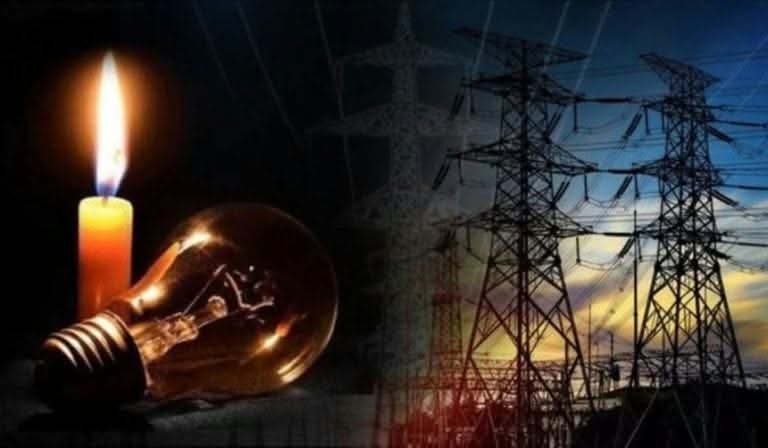
Business owners and residents of Kubwa, a satellite town in the Federal Capital Territory (FCT), have lamented mounting losses and hardship as a power outage in the area stretches beyond one week.
The affected residents, particularly traders dealing in perishable goods, said the prolonged blackout had destroyed food stocks, disrupted business transactions and forced operators to spend more on alternative power sources.
They expressed concern that the Abuja Electricity Distribution Company (AEDC) had not officially informed them about the cause of the outage or provided prior notice that would have enabled them to prepare for the disruption.
The affected stakeholders spoke with the News Agency of Nigeria (NAN) in Abuja on Sunday, describing the situation as frustrating and financially damaging.
Some business owners said they had lost millions of naira in stock and business opportunities, while others feared they might be unable to repay loans taken to finance their operations.
A food vendor, Eniola Aderenle, said she had purchased food items in bulk to last for a month, as she routinely stocked both perishable and non-perishable goods.
She explained that the perishable items were stored in her refrigerator but had gone bad following the prolonged outage.
“I have lost a lot of money. This is very frustrating and annoying. It is even more painful that no reason has been given for the outage,” she said.
Kunle Babalola, a frozen-food dealer, also described the situation as distressing, saying his entire stock had been damaged.
“I am so sad. I have lost so much money. The bank I took a loan from to stock my shop is after me. What am I supposed to do?” he asked.
For Tunde Aremu, a barber, the blackout has meant relying on a generator to keep his business running despite the high cost of petrol.
He said the additional expense was putting pressure on his earnings and his ability to provide for his family.
“Fuel is very expensive, but I have no choice, as I need to take care of my family and other household expenses,” he said.
Aremu faulted the absence of prior communication about the outage, noting that advance notice would have allowed residents and business owners to make alternative arrangements.
“When notice is given that there will be a power outage, it enables people to make arrangements on how to cope with the situation,” he said.
A housewife and mother of five, Becky Umukoro, said food stored in her refrigerator had also gone bad, adding to the household’s financial burden.
She described the situation as frustrating and disappointing, questioning why Nigerians continued to experience prolonged electricity disruptions despite the country’s abundant natural resources.
“For a country that has so many mineral resources, we should not be in this kind of predicament,” she said.
Another resident, Isabella Osahon, expressed frustration that Nigeria continued to struggle with electricity supply despite its standing as Africa’s largest economy by some measures.
She said electricity was essential to economic activity and questioned the feasibility of promoting electric vehicles in an environment where reliable power remained a challenge.
“Nigeria is talking about electric vehicles. With this kind of development, how do you charge the car batteries?” she asked.
Osahon urged the Federal Government to take urgent steps to address the country’s persistent electricity supply problems.
Other residents, including Robert Are, Dupe Ogbede and Elizabeth Okoro, also called for a speedy resolution of the outage.
They urged the relevant authorities to restore electricity to the community without further delay, citing the disruption to household activities and commercial operations.
AEDC blames transmission line fault
Efforts by NAN to obtain an official response from AEDC’s customer care service were unsuccessful, as calls and text messages were not answered.
However, an official of the company told NAN that the outage resulted from a technical fault on the 330-kilovolt Shiroro-Katampe transmission line operated by the Transmission Company of Nigeria (TCN).
The official assured residents that efforts were underway to address the problem.
The explanation points to a fault on the transmission network rather than necessarily a problem with the local distribution infrastructure. However, the duration of the outage has raised concerns among affected residents about communication, contingency arrangements and the time required to restore supply.
For business owners who depend on refrigeration and electricity-powered equipment, the disruption has translated into damaged stock, additional operating costs and lost revenue.
Residents are now awaiting the restoration of electricity, while affected traders face the task of rebuilding their businesses and recovering from losses incurred during the prolonged blackout.