
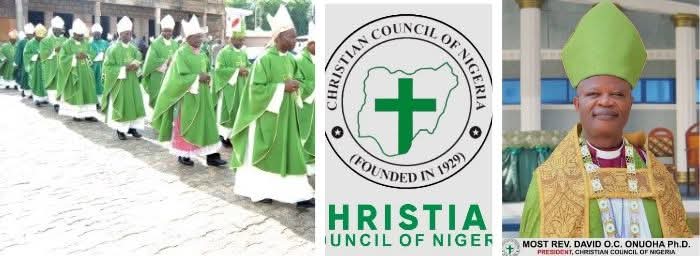
The President of the Christian Council of Nigeria (CCN), Most Rev. Dr. David O. C. Onuoha, has criticised the impact of Federal Government policies and reforms over the past three years, saying they have brought more hardship than prosperity to Nigerians and should be urgently reviewed.
Onuoha was speaking against the backdrop of the recent visit by the Catholic Bishops’ Conference of Nigeria (CBCN) to President Bola Ahmed Tinubu, during which the bishops raised concerns over the state of the nation.
The CCN president who is also the Anglican Archbishop of Okigwe South Diocese and the Archbishop of Owerri Ecclesiastical Province of Imo State defended the Catholic bishops’ intervention, rejecting attempts to attach political motives to their submission and insisting that they spoke to issues affecting Nigerians across religious, ethnic and political divides.
“The truth remains that the Roman Catholic Bishops Conference spoke not for the Church or any other body, but for the entire nation,” Onuoha said.
He maintained that the issues raised by the bishops before the President were genuine concerns confronting citizens, regardless of their tribe, religion or ethnicity.
“The matters they raised before the President were real, and affect every Nigerian, irrespective of tribe, religion or ethnicity,” he added.
Onuoha urged the Federal Government to respond to such concerns through constructive engagement and policy adjustments rather than criticism of those raising them.
He argued that the Church should be regarded as a partner in governance and national development because religious leaders maintain direct contact with citizens and are therefore able to provide valuable insight into the effects of government policies at the grassroots.
“Rather than castigate them or live in denial of the pain, suffering, hardship, poverty and insecurity that are a present reality in Nigeria today, the Federal Government should see the Church as a partner in the search for a Nigeria that works,” he said.
According to him, religious leaders interact regularly with Nigerians in both urban and rural communities and are exposed to the difficulties confronting ordinary citizens.
“Religious leaders are in constant touch with the people, both in the urban and rural areas. They live among them, and should be trusted for an unbiased assessment of how government policies affect the people of this nation,” he said.
The cleric also warned President Tinubu against aides and officials who might shield the administration from negative realities in an attempt to defend the government or retain their positions.
“The President should be wary of those assistants and staff who make enemies for the administration in the guise of defending the government,” he warned.
“Those around the President, who present false pictures of the situation of things in the country in order to keep their positions and offices, are the real enemies of the people.”
During Bishops visit and prayer with Buhari in 2016
Onuoha said any leader genuinely committed to the welfare of citizens must have the courage to listen to criticism and accept the truth regardless of its source.
READ MORE Gov. Obaseki draged to court for fake Unibadan certificate
He cited the biblical injunction that “you shall know the truth and the truth shall set you free”, stressing that criticism from credible stakeholders should be viewed as an opportunity for correction rather than an attempt to undermine government.
The CCN president commended the Catholic Bishops’ Conference for what he described as its consistent and courageous interventions on issues affecting the nation.
“The Catholic Bishops Conference of Nigeria should be commended for its constant, bold and courageous interventions for the wellbeing of the nation,” he said.
He cautioned against singling out or vilifying individual bishops over their contributions to national discourse, arguing that doing so could discourage constructive engagement between government and religious institutions.
Onuoha warned that ignoring credible concerns raised by religious leaders and other stakeholders could have serious consequences for governance and the welfare of Nigerians.
He therefore called for a review of government policies and reforms introduced over the past three years, with particular attention to their impact on the living conditions and security of citizens.
“For the avoidance of doubt, government policies and reforms in the last three years have produced more adversity than prosperity,” he said.
The CCN president stressed that reviewing policies to achieve a more positive impact on Nigerians, while ensuring that citizens are safe and secure, should not be viewed as a political concession but as a fundamental responsibility of government.
The Catholic bishops’ latest engagement with President Bola Ahmed Tinubu is not without precedent. The CBCN has maintained a tradition of direct engagement with successive administrations, using such meetings to offer counsel, express solidarity and raise concerns about issues affecting the country.
On 13, November 2014, as reported by the Nation Newspaper, the bishops visited President Goodluck Jonathan at the Presidential Villa and used the occasion to raise concerns over worsening insecurity, displacement and the loss of territories to insurgents.
The leader of the delegation then, Bishop Ignatius Kaigama said, “things are not right” and that Nigerians were being displaced.
In February 2015, Jonathan also addressed the bishops during their plenary meeting ahead of the general elections, assuring them of his commitment to a credible democratic process.
A year later, on May 2, 2016, the CBCN’s Administrative Board met President Muhammadu Buhari at the Presidential Villa. While congratulating Buhari and expressing willingness to collaborate with his administration, the bishops raised concerns about insecurity, killings and economic hardship and sought investigations into attacks in communities including Agatu in Benue State and Nimbo in Enugu State. The pattern demonstrates that CBCN’s engagement with the presidency has historically combined cooperation with frank counsel and criticism.
’