
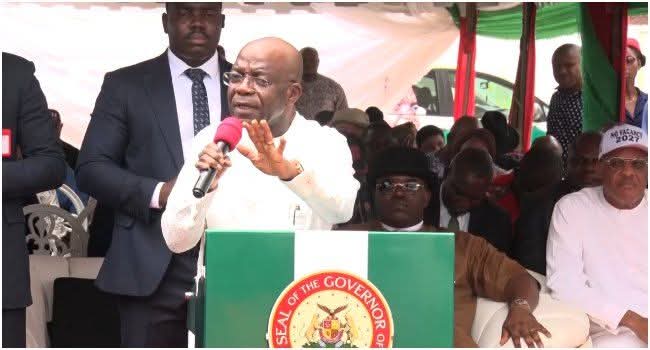
Abia State Governor, Alex Otti, has declared that he will retire from active politics after completing his tenure, saying younger Nigerians should be given greater opportunities to assume leadership positions.
Otti made the declaration on Thursday in Umuahia, the Abia State capital, while speaking on the importance of good governance and the need for political leaders to create opportunities for younger generations.
The governor said he had no intention of remaining in active politics after completing his tenure and specifically ruled out seeking election to the Senate.
“Once I finish this one, I will retire. Why do I say so? I want the young people to take over,” Otti said.
He identified good governance as one of the most important responsibilities of government, arguing that citizens who experience effective leadership would be reluctant to return to what he described as poor governance.
“The most important thing you can give a people is good governance,” he said.
Otti also rejected the idea of becoming a political godfather after leaving office, saying he did not believe in the practice of political leaders seeking to maintain influence by controlling the emergence of their successors.
“I don’t want to be a godfather. And I don’t tolerate godfathers,” the governor said.
According to him, the people of Abia should be able to assess candidates and determine who is best qualified to succeed him rather than being directed by a political leader.
“So, if you are afraid that we will go back to Egypt, it will never happen. We will all sit down, look at everybody and say, who is the best person for this job? And all of us will agree, and we will campaign for him; he will win. We will take a back seat,” Otti said.
The governor’s comments come as political parties and politicians across Nigeria prepare for the 2027 general elections, with debates over succession, leadership and the participation of younger Nigerians featuring prominently in political discussions.
Otti said his decision to leave active politics was deliberate and that he was not interested in seeking another elective position after completing his tenure as governor.
“I keep saying it, I’m not interested in anything else. I don’t even want to go to the Senate. I’m not interested,” he said.
He argued that political leadership should not become the permanent preserve of a particular group of individuals and called for greater opportunities for younger Nigerians who, he said, possess the education, skills and capacity to contribute to governance.
“We should stop this sit-tight; it’s only you. Not only you, it also can’t be only you,” Otti said.
“There are smarter, more trained, better trained, better equipped younger people. Our children, we need to give them opportunities.”
The governor’s remarks also touched on the relationship between governance and public expectations. He said once citizens became accustomed to good governance, they would demand its continuation and resist efforts to return them to previous conditions.
His reference to not “going back to Egypt” was used in the context of maintaining whatever improvements citizens may experience under his administration and ensuring that future leadership does not reverse them.
Otti has previously been involved in political activities beyond his role as governor. Channels Television reported in January 2026 that the Labour Party’s National Working Committee affirmed him as the party’s national leader following Peter Obi’s departure from the party for the Nigeria Democratic Congress.
His latest statement, however, suggests that he does not intend to use his political position to remain active in elective politics after his tenure.
The governor’s emphasis on generational change comes against the backdrop of continuing discussions about the role of younger Nigerians in political leadership. Otti said younger people should not merely participate in politics as supporters or campaigners but should also be given opportunities to occupy positions of responsibility.
He argued that political leaders should recognise that leadership is not the preserve of one individual or generation.
For Otti, the process of succession should therefore involve identifying competent individuals capable of sustaining good governance rather than simply selecting someone because of personal loyalty or political patronage.
His comments also appeared to reject the traditional model in which outgoing political leaders seek to retain influence by determining their preferred successors and maintaining control over political structures after leaving office.
Instead, he said citizens should have the opportunity to examine the available choices and collectively support the person they consider suitable for the job.
Otti’s declaration means that, based on his stated position, he intends to leave elective politics after completing his current tenure and does not plan to pursue a Senate seat or another political office.
He also said he hoped younger Nigerians would take advantage of the opportunities available to them and prepare themselves for leadership.
“We should stop this sit-tight,” he reiterated, stressing that there were younger Nigerians who were “better trained” and “better equipped” and should be given opportunities to serve.
The governor’s remarks place generational transition and succession at the centre of his stated approach to political leadership, while his position on retirement will ultimately be tested by his actions when his tenure comes to an end.